The Story Behind EHMS: Hospital Software for a Trust Eye Hospital in Chishtian
How we built hospital management software for a trust eye hospital in Chishtian, moved it to the web as EHMS, and why it beat SAP and Odoo for them.
Read articleTurner 10, a real estate ERP built in Bahawalpur, has run housing schemes in Bahawalpur, Yazman and Khairpur Tamewali since 2016, in Urdu, English and Arabic.
Turner 10 started as an order. In 2016 a developer asked us to build software for one housing scheme in Bahawalpur, Al Rahim Town, a Hussain Developers project. We built it, kept improving it, and the next project came, then the next. Today the same real estate ERP, rebuilt and extended over the years, has run seventeen projects across Bahawalpur, Yazman and Khairpur Tamewali, and two more signed up in 2026.
This post is about what is inside it and why it is shaped the way it is. If you are a property developer in Pakistan comparing real estate ERP options, or an operations head trying to get a scheme off registers and Excel, the sections below are the ones to read closely. If you are still deciding what to look for, start with our guide to real estate software in Pakistan, which covers where schemes lose money, how fast software pays for itself and how to choose a vendor.
Most of what Turner 10 does today exists because one of these schemes needed it. That is the advantage of a decade with the same kind of customer: the edge cases stop being surprises.
The best review Turner 10 ever got was not a review. One of these clients asked us to build software for a friend's trust eye hospital in Chishtian, because Turner 10 had worked so well for him. That referral became EHMS, our hospital management system, and the full story is in hospital management software in Pakistan: the story behind EHMS.
If you run a housing scheme on registers, Excel sheets and a WhatsApp group, Turner 10 was built for that starting point. If you run one scheme today and plan the next one, every project gets its own workspace under the same login, with a Head Office workspace on top. And if you have looked at generic ERP software and found that none of it understands installment recovery, land owner shares or block-wise plot numbering, this is the kind of real estate ERP we build.
Property development in Pakistan is not one business. It is five.
There is the sales floor, where plots get booked, cancelled, resold and transferred. There is money, which is harder than it sounds because installment schedules run for years and part payments arrive in pieces. There is the land itself, bought from owners who are often still owed plots and cash. There are investors who put money in and expect plots or returns back. And there is ordinary business admin: staff, payroll, vendors, and legal notices to defaulters.
So the home screen is a workspace of five groups: Sales floor, Money, Land and parties, Oversight and Administration. Each group holds the modules that someone in that job actually opens in a day. The counter at the top shows how many modules are open to you out of the total. A booking officer does not see payroll. An accountant does not see land owner agreements unless his role allows it. Nothing is greyed out; if your role does not include it, it is simply not there.
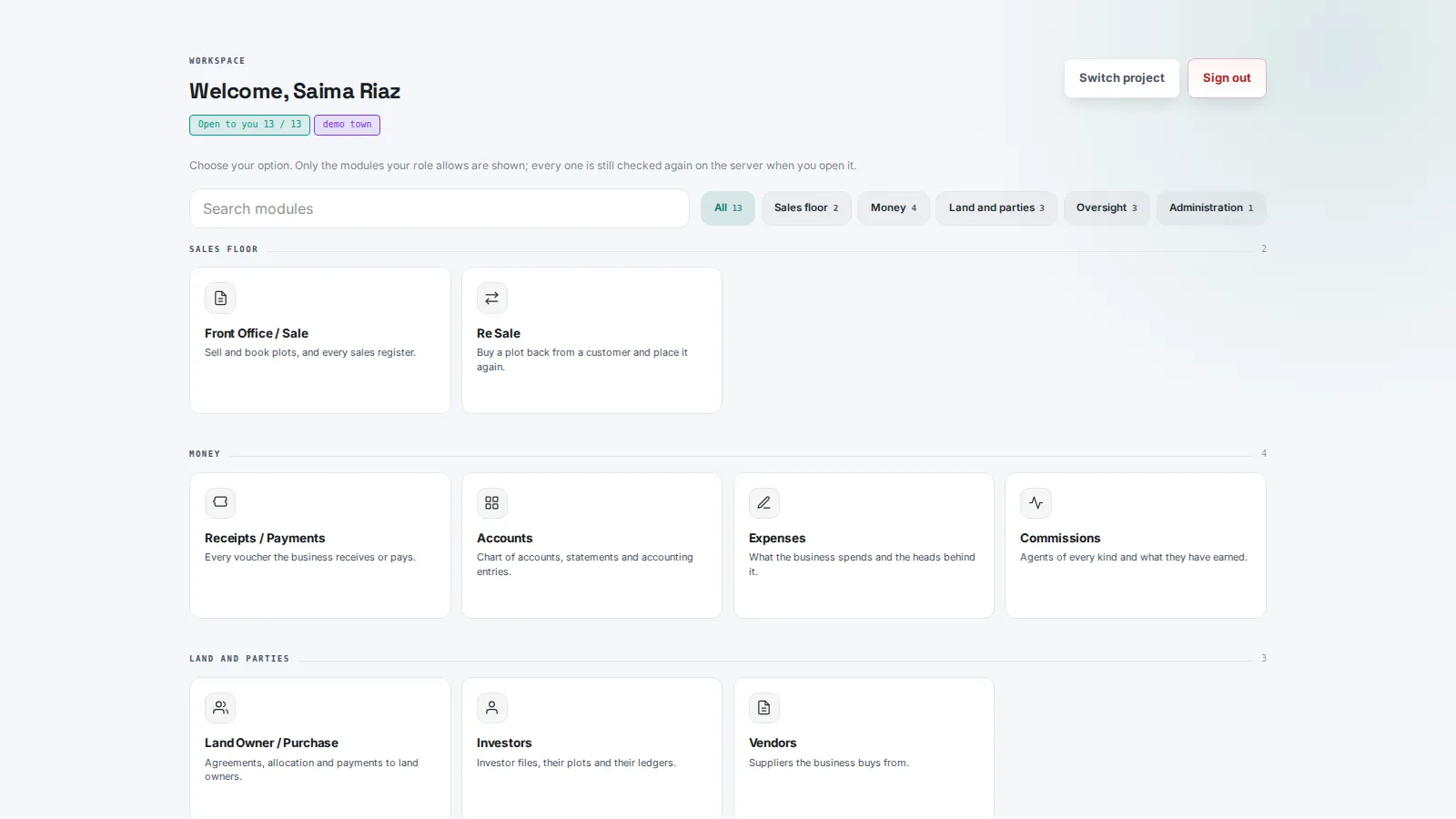
Every module checks your access on the server, every time you open it.
The screen already knows your role, so why ask the server again? Because the screen is a convenience that runs in the user's own browser, and anyone with developer tools can change what it shows. Access control that only lives on the screen is a suggestion. In Turner 10 the workspace shows modules based on your role, and then every actual open is authorised again on the server.
Front Office / Sale looks small: one place to do the work, Add Sale / Sale Action, and six registers. It is the hardest module in the system.
A sale in a Pakistani housing scheme is not one transaction. It is a chain. A booking with an advance, then an agreement, then installments across years. The customer can sell the file back before completion. The developer can resell the plot to someone else at a different price on a different plan. Each step has to reach the books: commissions already paid may need reversing, a land owner's share may shift, the old customer's ledger has to close and the new one open with the right balance.
Real cases never follow one script. A cancellation is mutual and half the booking is refunded. An investor takes a different plot in place of a cancelled one. A dealer takes a smaller commission on a resale because he brought both sides. So instead of one rigid wizard, the work happens through Add Sale / Sale Action and Re Sale, and everything you need to look up sits in the registers: List of Sales, Available Plots by block and size, Cancelled Plots, Resale Plots, Profit / Loss on Cancellation, and the Registries List. The booking officer works in the first. The accountant reads the second.
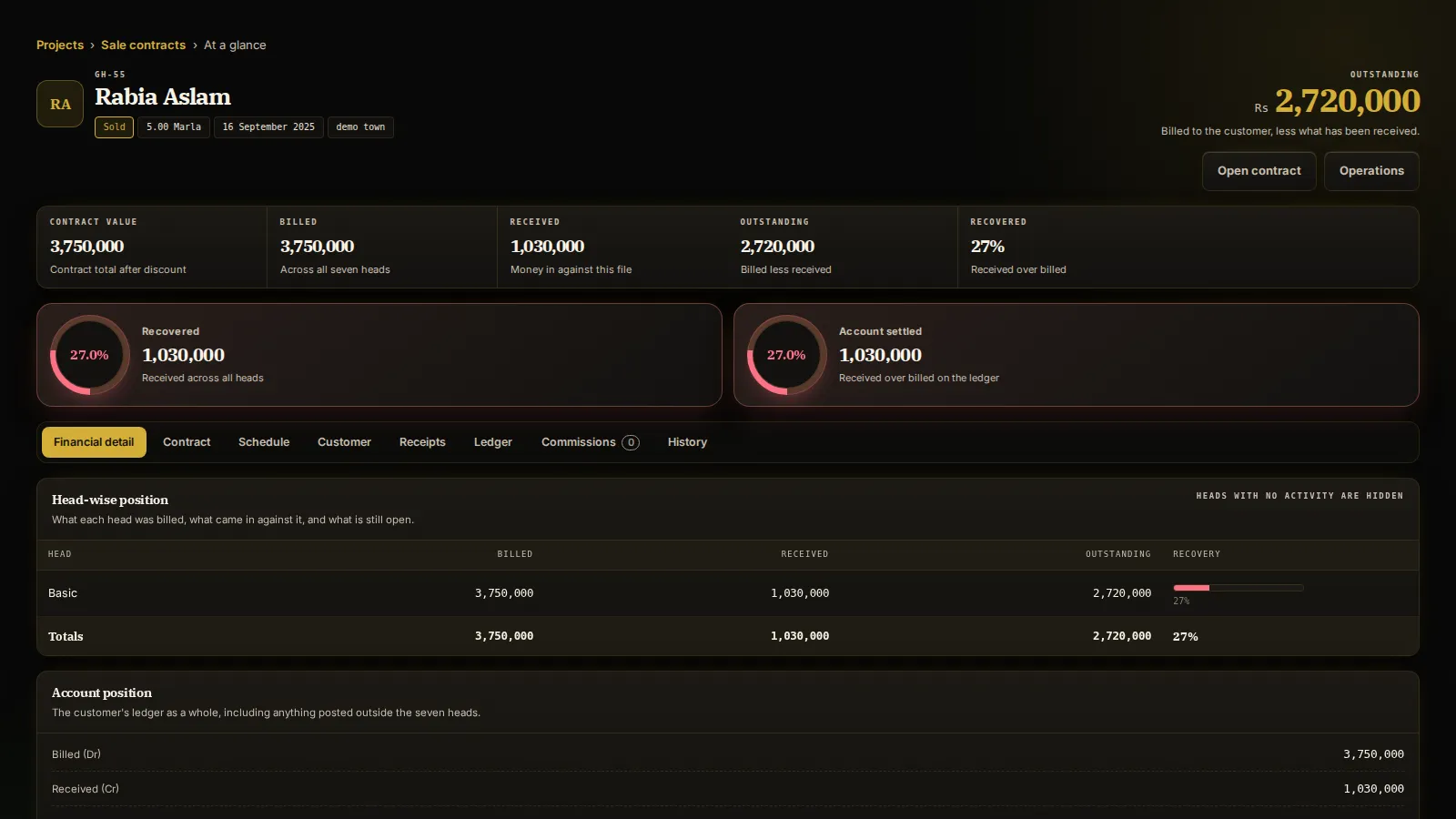
Every sale contract also opens into an at-a-glance view: contract value, billed, received, outstanding, recovery against each head, and tabs for the schedule, receipts, ledger, commissions and history.
An accounting module is not something to bolt on later. Operational data has to land in the ledger the moment it happens, or the ledger drifts, and one missed voucher on a Thursday means a Trial Balance that does not match the bank on Monday.
In Turner 10 every receipt and payment posts a balanced journal entry, and a voucher can never be deleted, only corrected. The chart of accounts runs four levels deep (Main, Main Sub, Main Sub Sub and Ledger accounts), and the Daybook, Trial Balance, Balance Sheet, Income Statement and Account Ledger come straight from those entries. Contra vouchers move money between your own accounts, and vendor purchases record what you owe suppliers.
If you only build one module well in a real estate ERP, build this one.
The Installment Recovery screen opens on three numbers: due (scheduled to date), recovered (collected against the schedule) and remaining (still to collect). Under them, how many installments there are, how many are overdue, and how many customers need a call today.
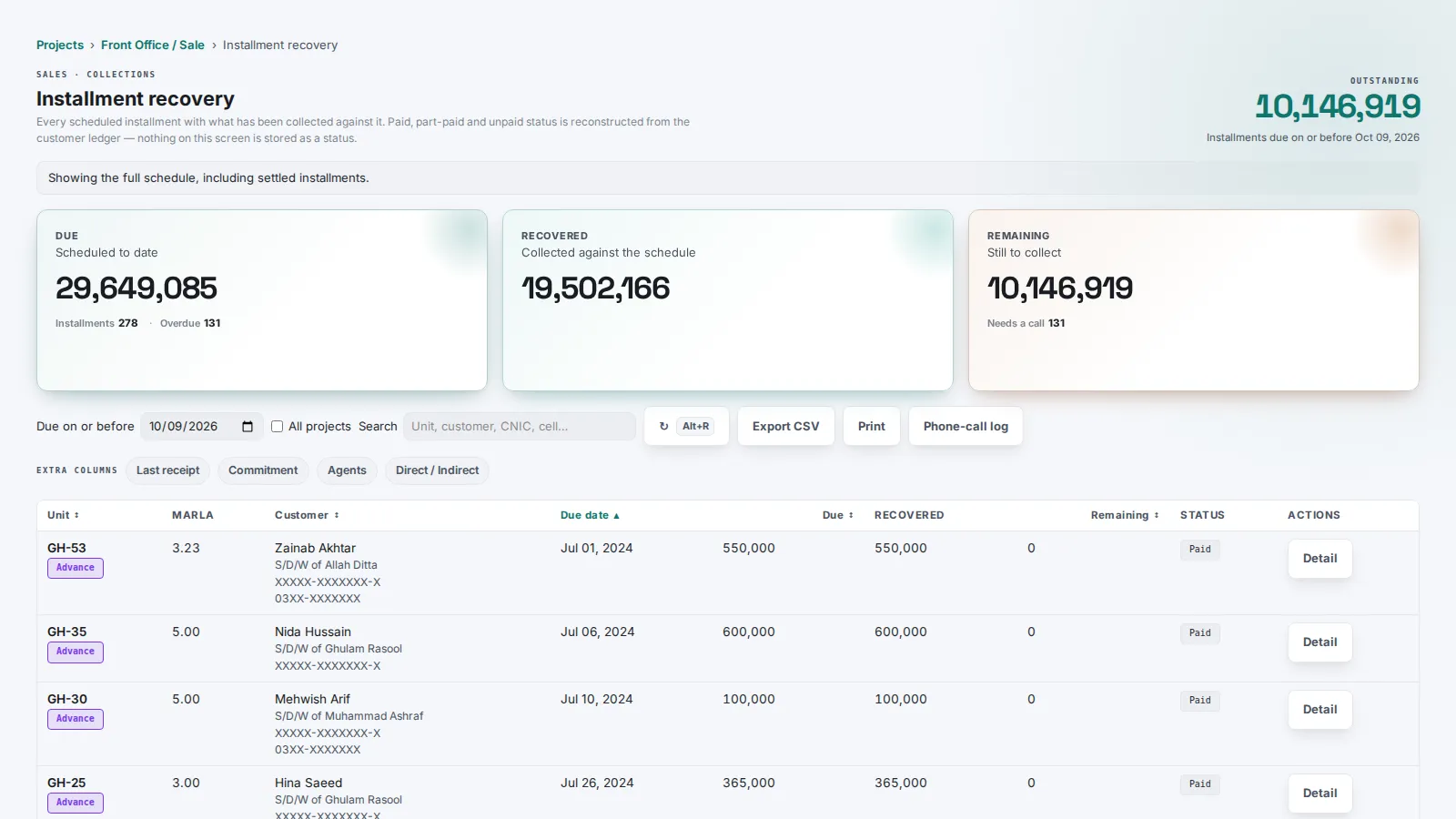
Then the table: every installment, every plot, every customer, searchable by unit, name, CNIC or mobile, filtered by due date and project. Extra columns show the last receipt, the customer's latest commitment, the agent, and whether the sale was direct or through a dealer. Paid, part-paid and unpaid are worked out from the customer's ledger every time, so no status can be typed in wrongly. Opening a row shows that customer's installment, ledger balance and commitments at a glance, with a button to log a new one.
Every follow-up goes into the phone-call log, so the next officer picks up where the last one left off. There is CSV export and print on the lists, because recovery officers here still take a printed list into the field. When calls stop working, the Legal Notices register tracks each notice, its stage and its escalation.
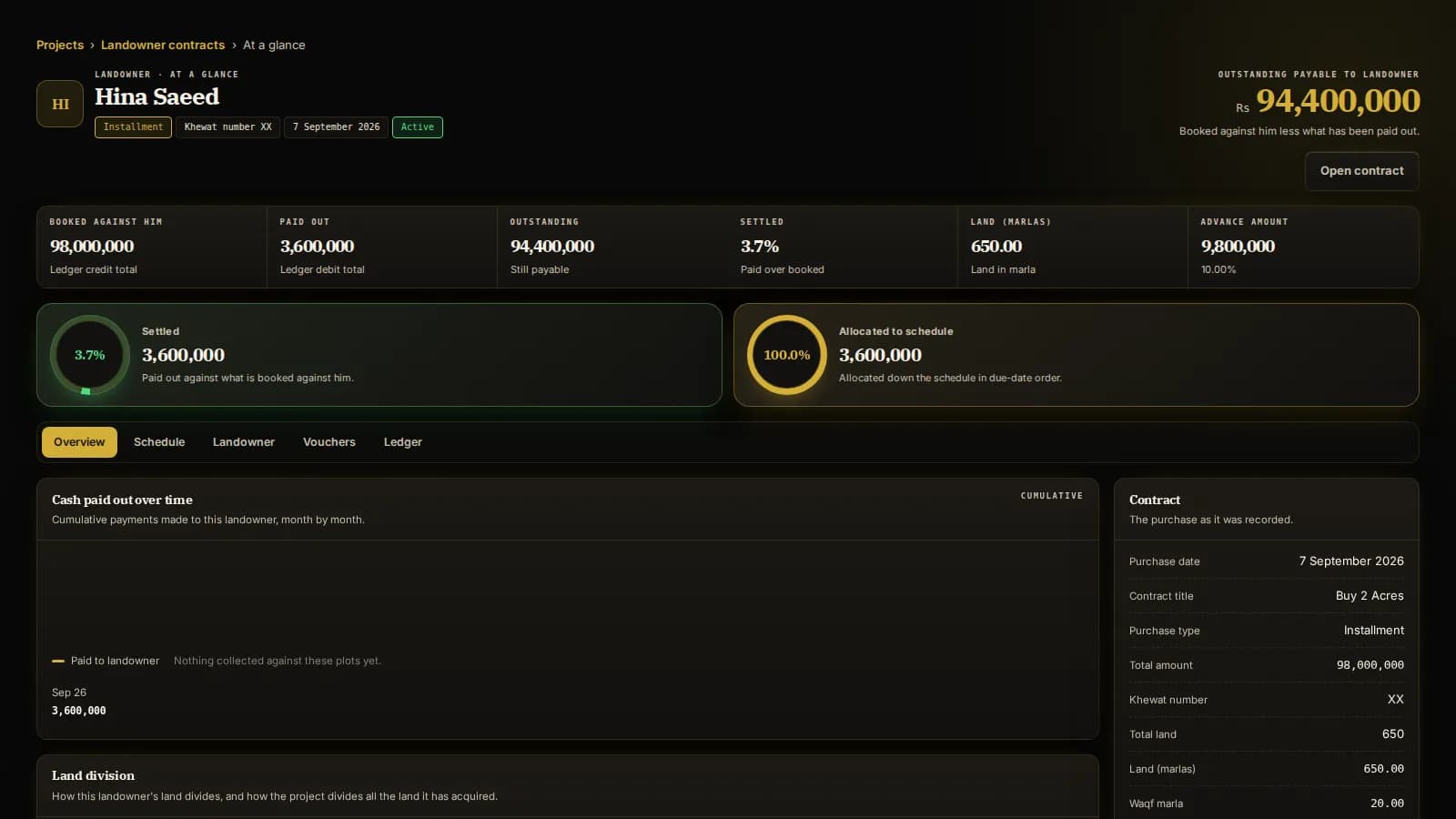
Every developer buys land from someone, often a farmer or a family, and the payment is rarely one-shot. The land owner is promised plots on his own land and cash in stages, and he has a ledger of his own where the developer owes him.
Land owners are not customers and they are not vendors. They are their own thing, with plots and cash flowing both ways. Land Owner / Purchase covers it: add and list agreements, the land owner profiles, plot allocation against the fard record, allocated plots per owner, land distribution across owners, and payments against each agreement.
A sale usually touches more than one person who expects a cut, and they are not paid the same way. Turner 10 keeps them apart: Agents, Freelancers, Employee Agents, Sales Officers and Investor Agents, each with their own list, plus Commission Payments and a Commissions List across all of them. Lumping them into one table gets the commission wrong for most of them.
Investors have their own module too: investor files, sub-investors under a main investor, and investor receipts and payments.
Employees covers staff files, HR reference data (departments, designations, salary heads), monthly payroll runs with approval, payroll rules, and employee payments. Expenses and Vendors cover what the business spends and who it buys from. Admin holds the master data: the plot register, adding a single plot or a whole block at once, plot definitions (sites, blocks, sectors, floors, types and units), party profiles, projects, ledger configuration, cheque books and cheque leaves.
Turner 10 runs in English, Urdu and Arabic from one codebase, and the language can be switched before anyone signs in. Urdu and Arabic switch the whole layout to right-to-left, and Urdu text can use Nastaliq or Naskh.
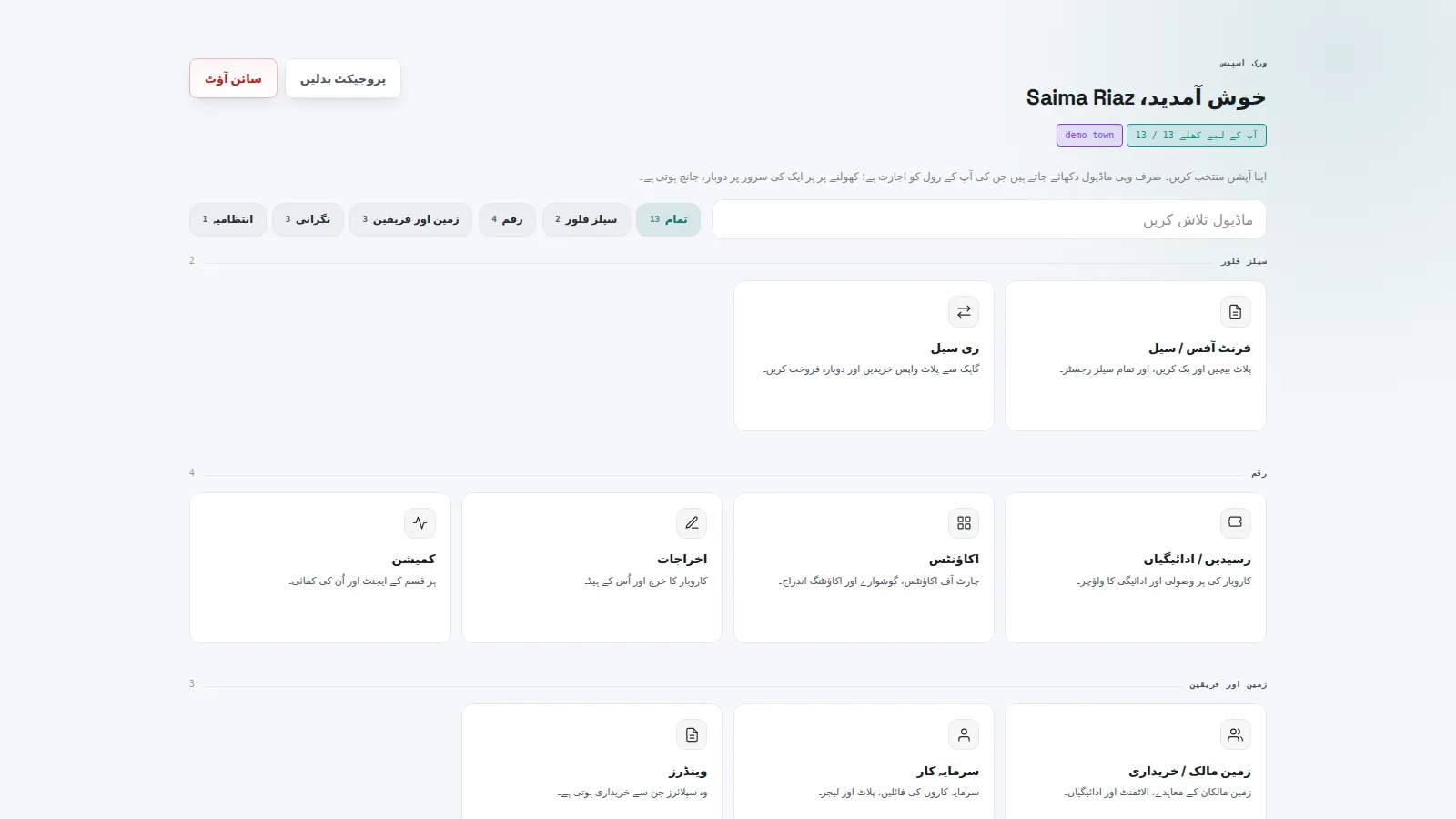
Right-to-left is not a toggle, it is a design pass. Icons that point one way in English have to flip. The chart of accounts tree has to mirror. Tables, numbers and dates have to stay readable in both directions.
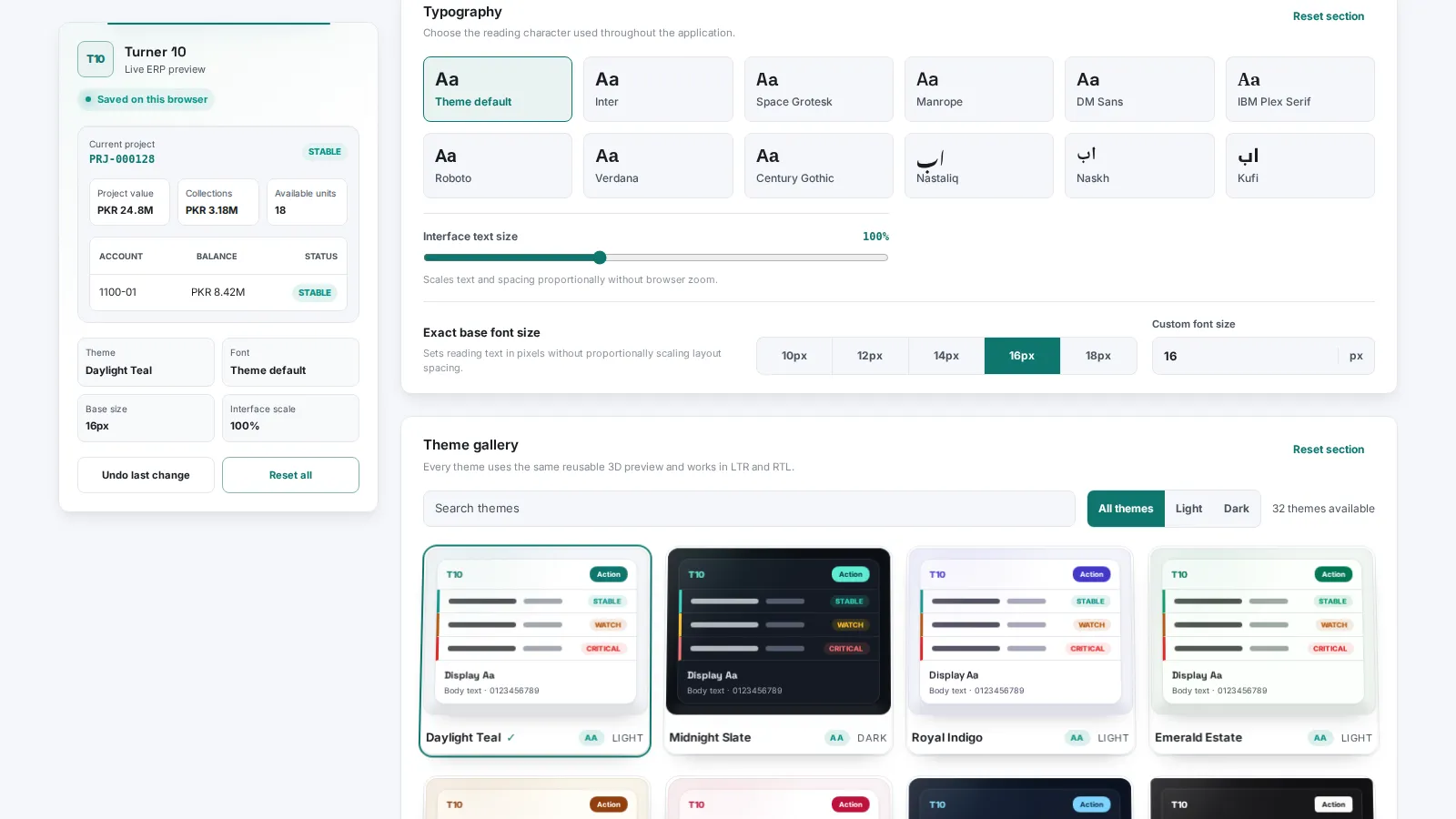
Each user can also set up the screen for themselves: 32 light and dark themes, from Daylight Teal to Black Gold, or a custom theme from your own brand colours; comfortable or compact tables; corner style; fonts; and text size.
Eaquirs Tech is based in Bahawalpur, and our real estate work grew up here. Every project above was sold in Bahawalpur, Yazman, Khairpur Tamewali and the towns around them. A block in a local scheme is numbered the way it has always been numbered. An installment plan runs for years on terms the developer agreed in person. A land owner from a nearby village expects his share tracked plot by plot, and expects to see his ledger on the screen when he walks in.
Most imported or generic property software does not model any of this. Turner 10 does, because it was built one local scheme at a time. We are happy to work with developers anywhere in Pakistan, and in the Gulf, where the Arabic version applies directly.
What is a real estate ERP? A real estate ERP is the single system a property developer uses to run the business end to end: plot inventory, sales and bookings, customer files, installment plans and recovery, resale and cancellation, land owner payments, investors, commissions, double-entry accounting, payroll and reporting. Generic ERP software does not model installment recovery or land owner shares, which is why most developers in Pakistan end up with software built for real estate.
How much does a real estate ERP cost in Pakistan? It depends on the number of projects, the modules you need, and how much data has to be moved across from registers and Excel. Our cost calculator gives a rough range in a minute, and after a free call we send a written plan with the exact number.
How long does it take to get started? Most of the time goes into bringing your existing plots, customers and installment schedules across, not into the software itself. We give you the timeline for your scheme in the written plan, after looking at your data.
Do you support Urdu and Arabic? Yes. English, Urdu and Arabic, with full right-to-left layout for Urdu and Arabic.
Can we start with one project and add more later? Yes. Each project is its own workspace under one login, with a Head Office workspace on top. The Al Rahim group, for example, has run seven projects on it.
Do you work with developers outside Bahawalpur? Yes. Our projects so far are in Bahawalpur, Yazman and Khairpur Tamewali, so site visits around South Punjab are easy. For other cities and abroad we run the discovery call over video.
We build real estate ERP software like Turner 10 for property developers in Pakistan and the Gulf, and we also build ERP for jewellery, retail and healthcare. The first deliverable is always a written plan with scope, timeline and estimate. It costs nothing and it is yours to keep.
See the full Turner 10 case study, read how to choose real estate software in Pakistan, try the cost calculator, or send us the brief and we will come back with a written plan within 48 hours.
Answer three quick questions and we'll send you a written plan with scope, team, timeline and estimate.
Monthly note
What worked on real client projects, what didn't, and the numbers behind it. Short enough to read over coffee.
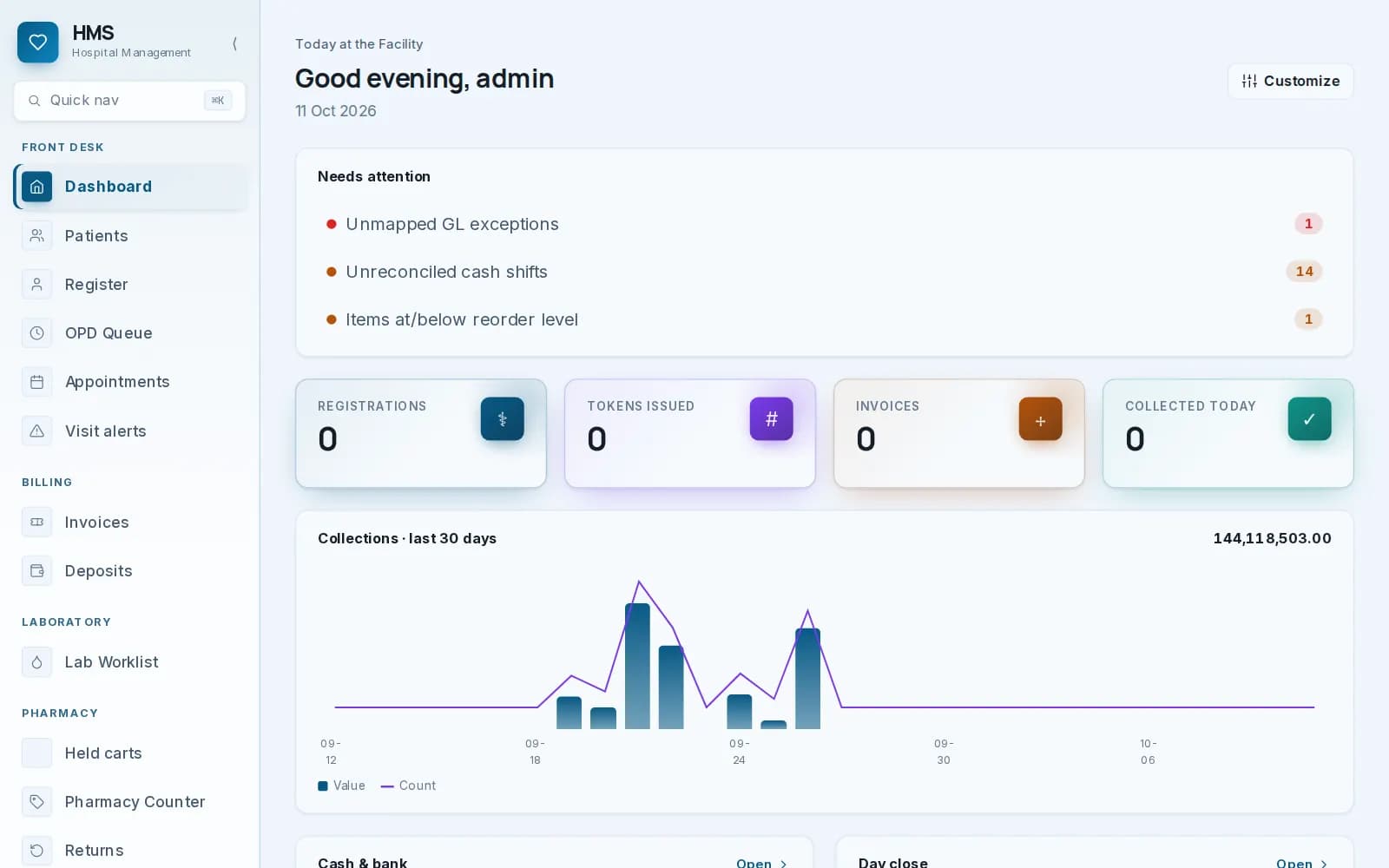
How we built hospital management software for a trust eye hospital in Chishtian, moved it to the web as EHMS, and why it beat SAP and Odoo for them.
Read article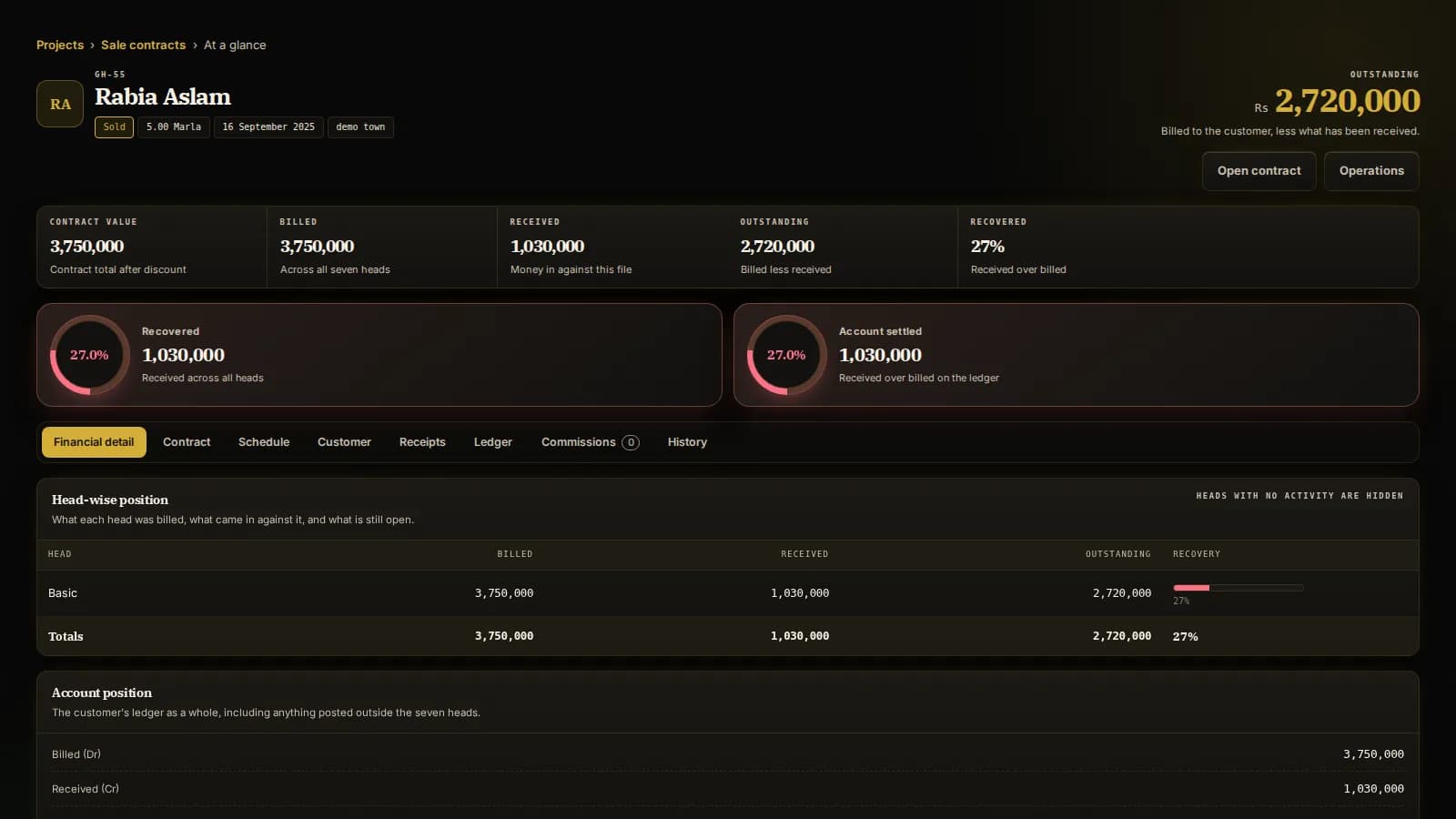
What real estate software must do for a housing scheme in Pakistan, from 17 projects in Bahawalpur, Yazman and Khairpur Tamewali: features, Urdu, cost, payback.
Read article
Zakat management software for trust hospitals in Pakistan: how EHMS keeps zakat, sadqa and charity money on separate ledgers, from a hospital in Chishtian.
Read article