ریئل اسٹیٹ سافٹ ویئر اردو میں: ہاؤسنگ اسکیم چلانے والوں کے لیے مکمل رہنمائی
پلاٹ بکنگ، اقساط کی ریکوری، ڈیلر کمیشن، زمین مالکان اور اکاؤنٹس، سب اردو میں۔ 2016 سے بہاولپور، یزمان اور خیرپور ٹامیوالی کے 17 منصوبوں کا تجربہ۔
Read articleWhat real estate software must do for a housing scheme in Pakistan, from 17 projects in Bahawalpur, Yazman and Khairpur Tamewali: features, Urdu, cost, payback.
In 2016 a developer in Bahawalpur asked me to build real estate software for one housing scheme, Al Rahim Town, a Hussain Developers project. Their plot files lived in a register, the installment record lived in another register, and the cash book was a third thing again. Ten years and seventeen projects later, that same software, which we now call Turner 10, runs sales, installments, land owners, dealers and accounts for housing schemes across Bahawalpur, Yazman and Khairpur Tamewali.
This is a guide for builders and property developers choosing real estate software in Pakistan, written from what those seventeen projects taught me. I will show you where the money leaks in a typical scheme, what the software has to do about each leak, how fast it pays for itself with your own numbers, and how to choose a vendor, whether that is us or someone else.
Every scheme I have seen loses money in the same five places. None of them show up as a loss in the books. They show up as a slow month, an argument at the counter, or a file nobody can explain.
Installments that nobody chased on time. A customer misses his 10th of the month. Nobody notices until the monthly review, because the register only tells you who paid, not who did not. By the time someone calls, he has missed two kists and the conversation is harder. Multiply that by forty or fifty files and you are financing your own customers, interest free.
A plot sold twice, or a file sold back and forth. In a busy booking season, two dealers can sell the same corner plot within a week. Resale and cancellation make it worse: the file comes back, gets placed again at a new price, and the old balance has to close cleanly. When that lives in registers, one missed line becomes a dispute that can freeze a plot for months.
Dealer commission paid on the wrong deal. Commission gets paid on a booking that was later cancelled. Or two agents claim the same customer. Or a sales officer on salary gets the freelancer's rate. Each case is small. Over a year they add up to a real number.
Land owner balances that live in someone's memory. The farmer whose land became Block C was promised plots and cash in stages. If his account is a page in a file, every visit to the office turns into a negotiation.
The month-end reconciliation. Your accountant spends days matching receipt books to the bank and to the sales register. That is not accounting. That is searching.
Every builder asks me the same thing before he signs: what does this actually earn me? Here is how I answer him. The numbers below are an example, not a promise, and not taken from any one client. Change them to your own scheme and the logic still holds.
Say your scheme has 400 plot files on installments and the average monthly installment is PKR 30,000. That means PKR 1.2 crore is scheduled to come in every month.
The biggest lever by far is recovery. The question is simple: how much more of that 1.2 crore would arrive on time if your recovery team started every morning with a list of exactly who is due, who is overdue, and what each customer promised on the last call?
| On-time recovery improves by | Extra cash in hand each month | Over 12 months |
|---|---|---|
| 2% | PKR 2,40,000 | PKR 28,80,000 |
| 5% | PKR 6,00,000 | PKR 72,00,000 |
| 10% | PKR 12,00,000 | PKR 1,44,00,000 |
Pick the row you believe. Even the cautious 2% row puts close to 29 lakh rupees in your hands a year earlier than it would otherwise arrive, and some of that money would never have arrived at all, because a file that drifts three or four months behind is the file that ends in a legal notice.
Then add the smaller items:
Now the payback formula, which is the only one that matters:
Months to pay back = what the software costs you ÷ the monthly gain you just worked out
If your gain is 6 lakh rupees a month, a system that costs a few times that pays for itself before the first year is out. If your scheme is small and your recovery is already tight, the payback takes longer, and you should know that before you buy.
I could show you charts. The evidence I actually trust is simpler. A builder does not order the same software for his next scheme unless the first one paid for itself.
Here is the list of projects that have run on it since 2016:
Seven of those seventeen carry the Al Rahim name. Qamar Garden came back for its second phase. The Ajmal Garden team ordered a second system for Al Haram. And in 2026 alone, two more projects have signed up. Nobody renews software out of politeness, and that is the return on investment I can stand behind.
There is one more kind of return I did not see coming. One of these builders trusted Turner 10 enough to recommend us to a friend of his in the UK, who runs a trust eye hospital in Chishtian. That hospital now runs on our software too. A builder does not hand you his friend's hospital unless his own system has earned it. You can read how that hospital management software was built.
Most real estate software for sale in Pakistan does three things: plot inventory, customer files and a receipt book. That covers the counter. It does not cover the leaks above. These are the parts that do.
The Installment Recovery screen opens on three numbers: due to date, recovered against the schedule, and still to collect. Under them, how many installments are overdue and how many customers need a call today. Below that, every installment, every plot, every customer, with search by unit, name, CNIC or mobile number.
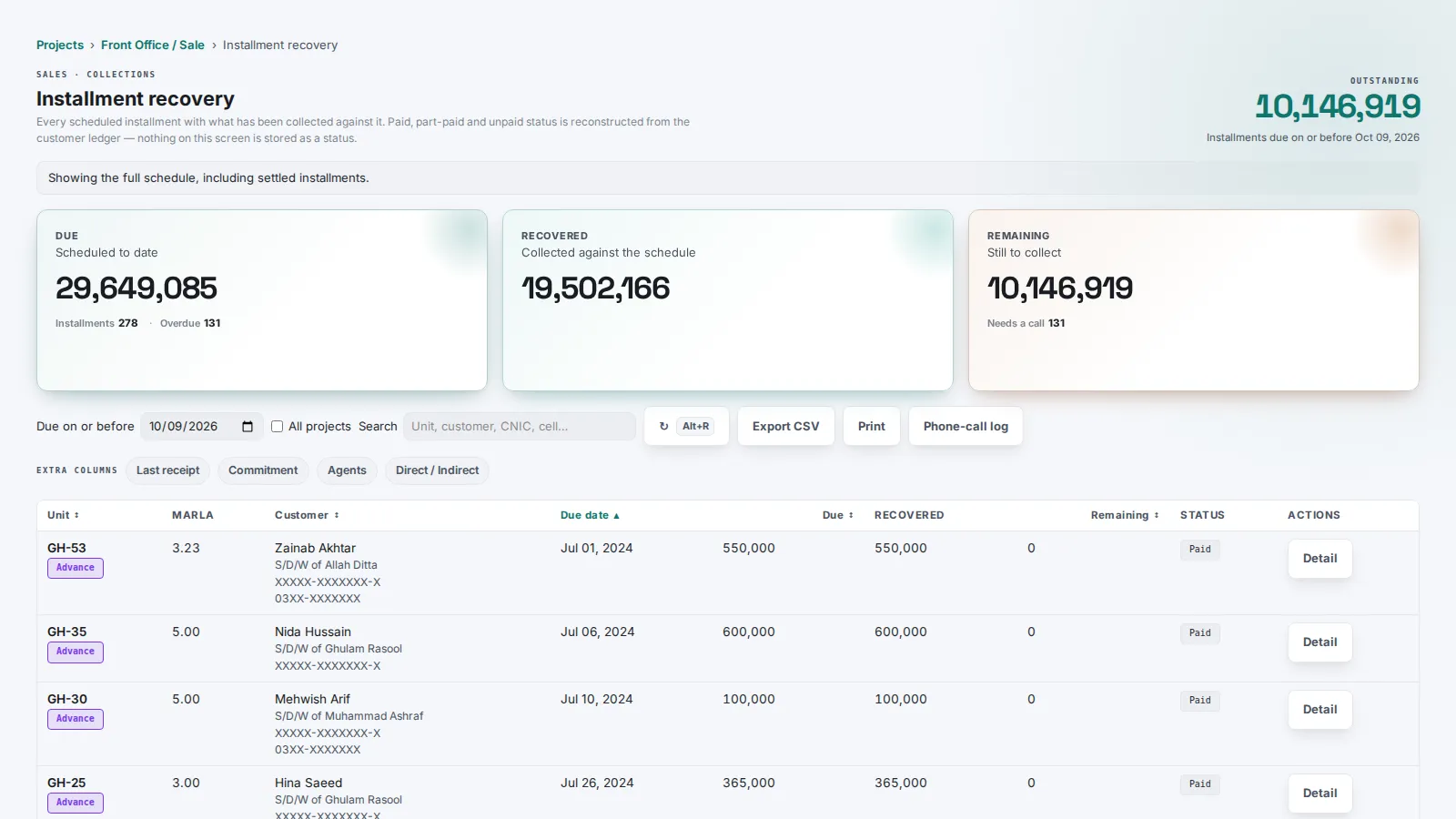
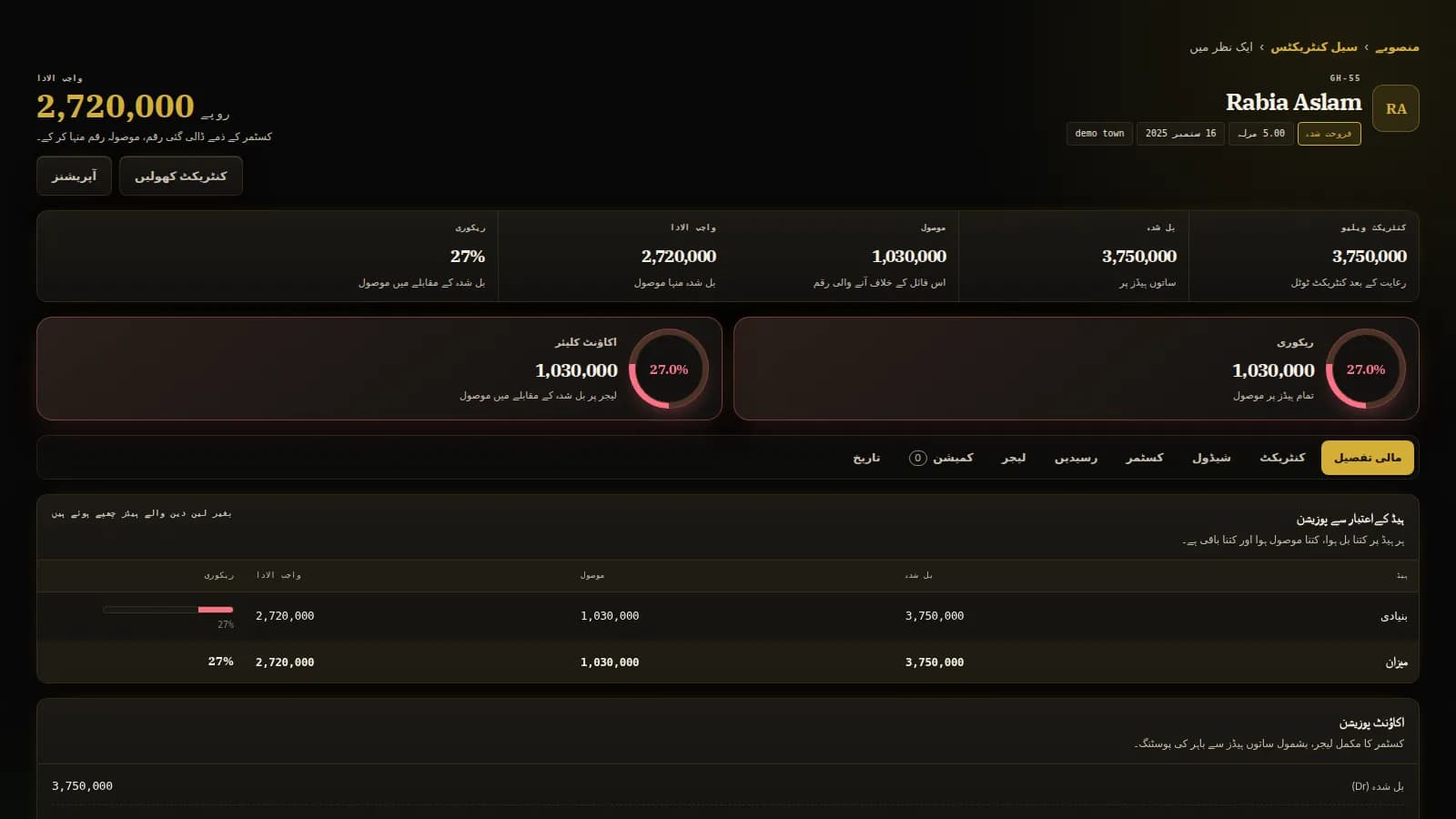
Two details matter more than they look. First, paid, part-paid and unpaid are worked out from the customer's ledger every time. Nobody types "paid" into a box, so nobody can type it wrongly. Second, every call goes into a phone-call log, and every promise a customer makes goes in as a commitment. The officer on tomorrow's shift knows what was promised today. There is CSV export and a print button too, because recovery officers in our part of the world still take a printed list into the field, and they are right to.
When a customer stops answering, the Legal Notices register tracks each notice, its stage and its escalation, next to the recovery call history.
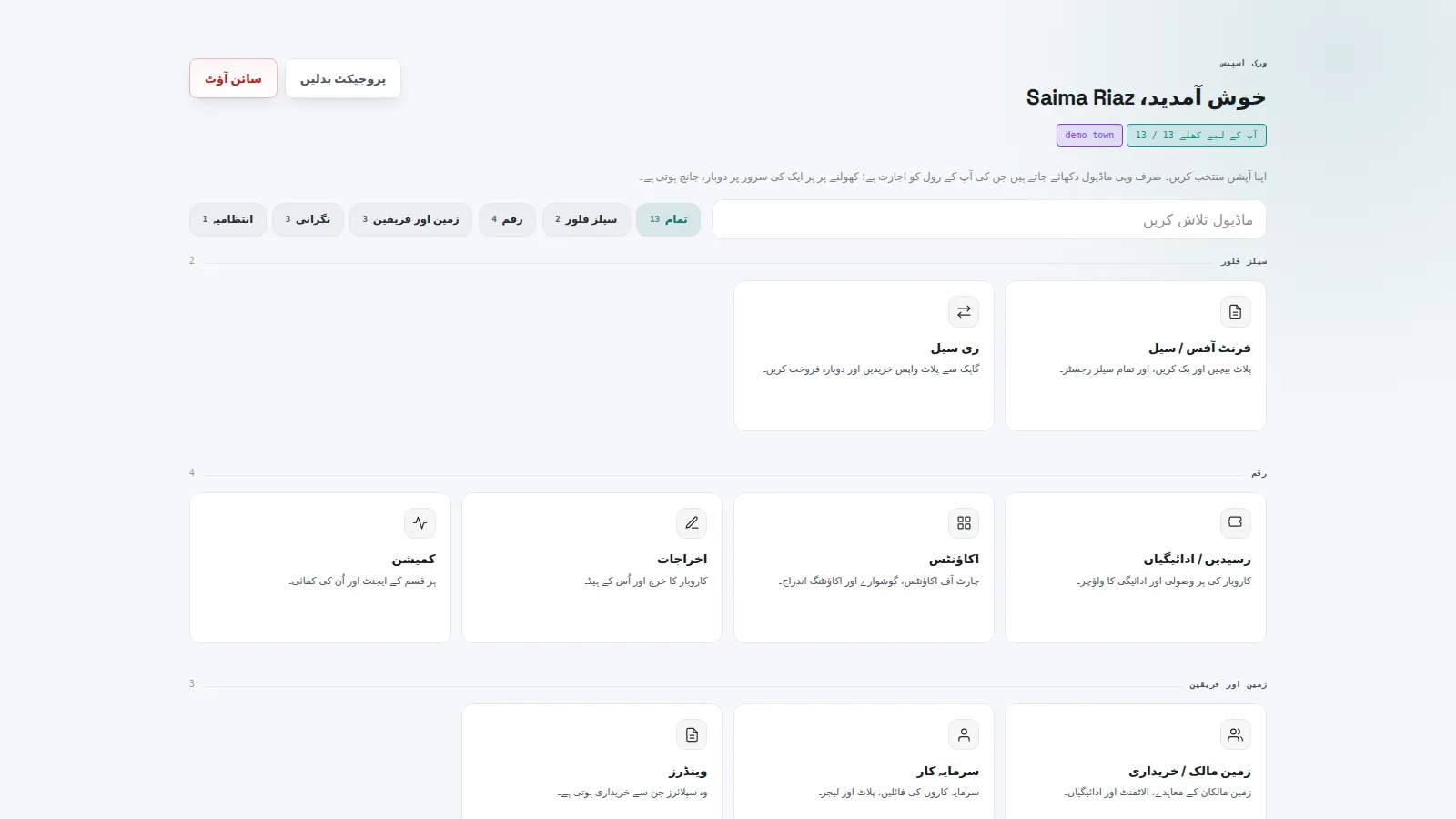
Front Office / Sale has one place to do the work, Add Sale / Sale Action, and six registers to look things up: list of sales, available plots by block and size, cancelled plots, resale plots, profit or loss on each cancellation, and registries recorded against each plot. Re Sale handles the case every scheme has: buying a file back from a customer and placing the plot again, with the old balance closed and the new one opened.
Commissions are split by who earns them: agents, freelancers, employee agents, sales officers and investor agents. Each has its own list and its own payments. Investors have their own files too, with sub-investors under a main investor and money moving both ways.
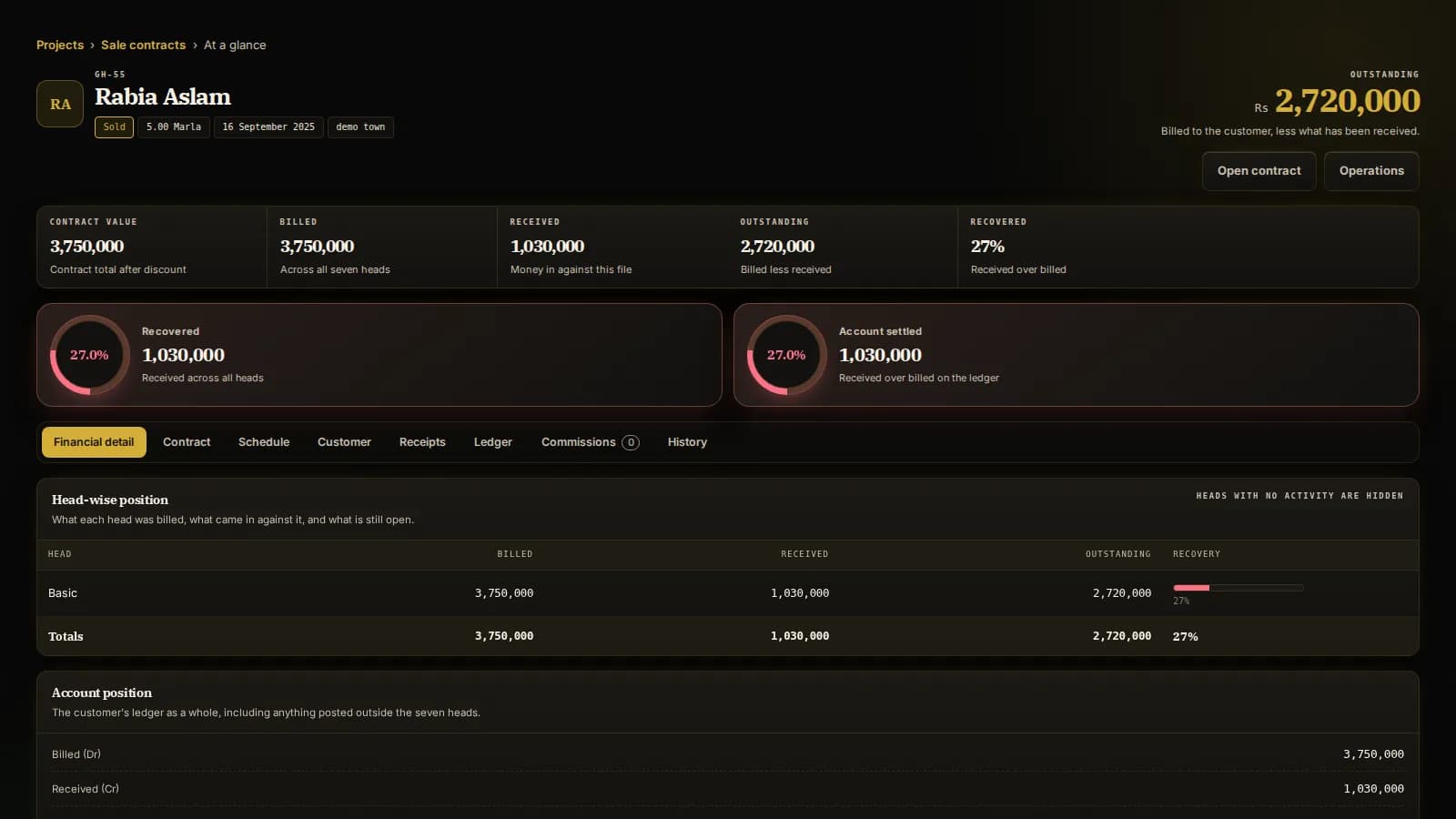
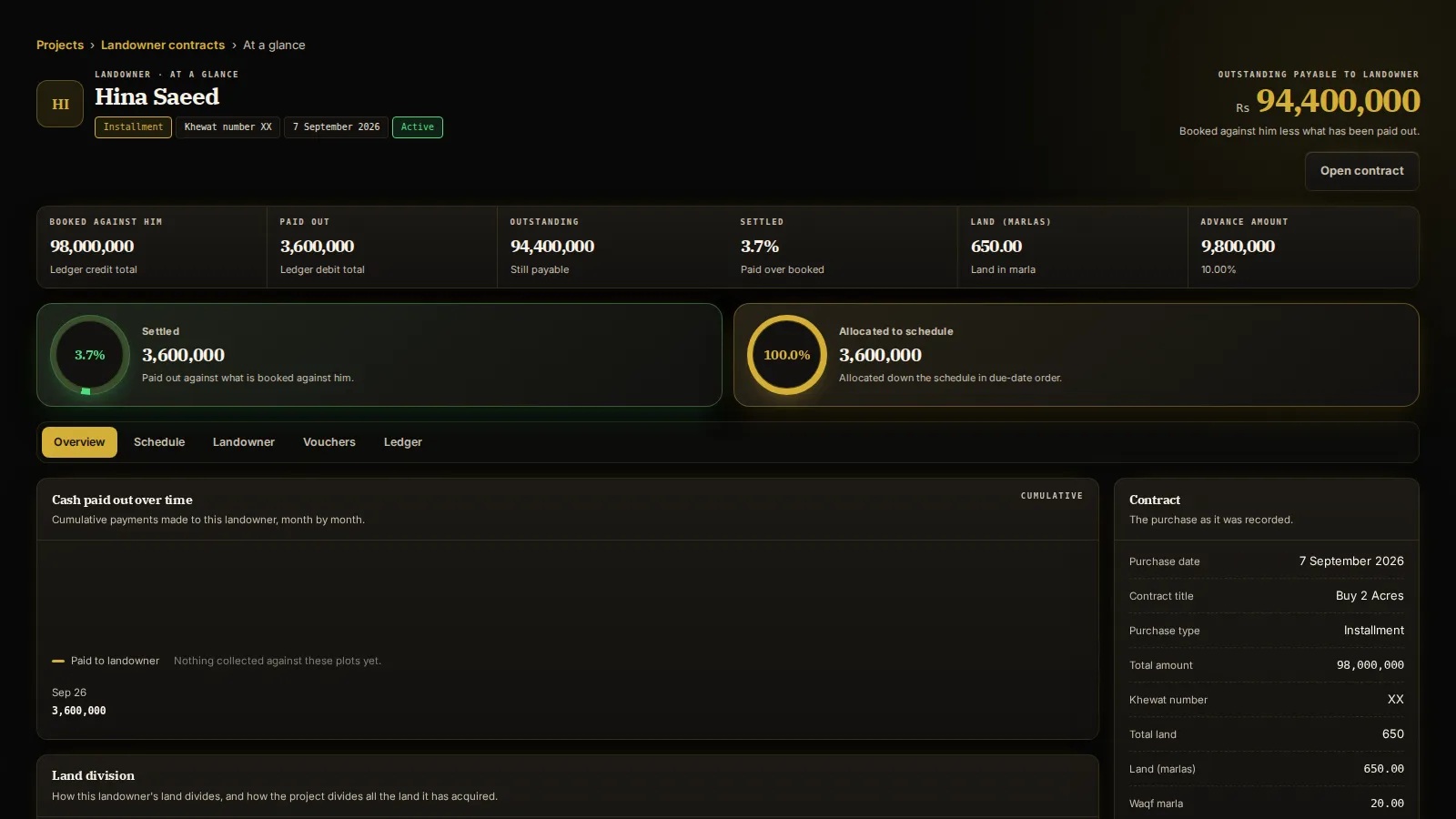
Land Owner / Purchase records the purchase agreement, allocates the bought land into plots against its fard record, tracks how developed land is split back across owners, and pays each owner against his agreement. When the land owner walks in, his balance is one screen, not one argument.
Every receipt and payment posts a balanced journal entry, and a voucher can never be deleted, only corrected. The chart of accounts runs four levels deep, and the Daybook, Trial Balance, Balance Sheet, Income Statement and Account Ledger come straight from those entries. Payroll and expenses post to the same books.
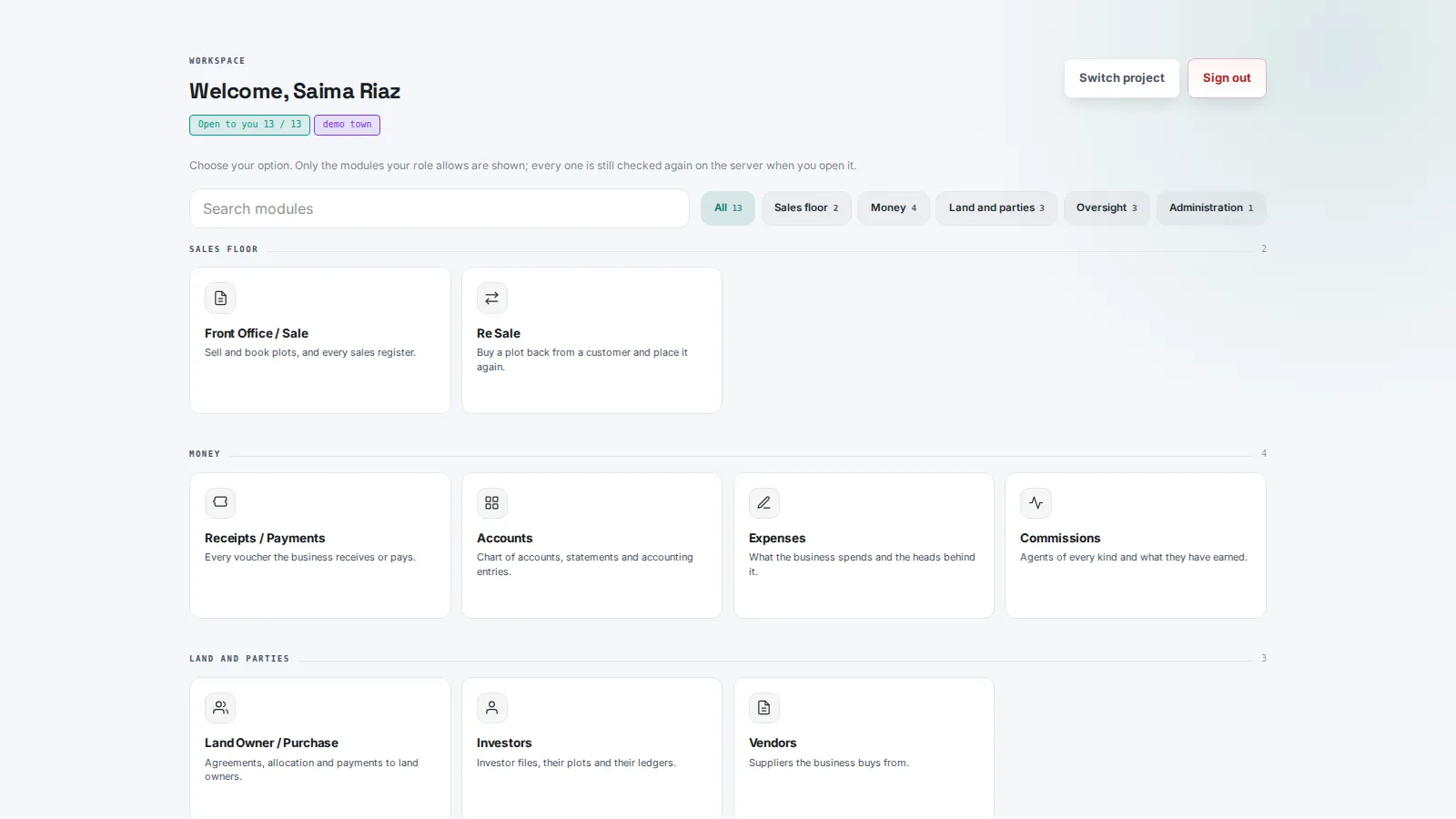
Each scheme is its own workspace, with a Head Office workspace above them. Staff only see the projects and modules their role allows, and every module is checked again on the server when it opens. For a group like Al Rahim with seven projects, that is the difference between one system and seven spreadsheets.
Turner 10 runs in English, Urdu and Arabic, with the layout flipping right-to-left for Urdu and Arabic, and the language can be picked before anyone signs in. Urdu text can use Nastaliq or Naskh.
| Registers and Excel | Generic accounting software | Turner 10 | |
|---|---|---|---|
| Installment schedule per plot | Manual | No | Yes, from the ledger |
| Daily due and overdue list | No | No | Yes, with call log |
| Guard against double booking | No | No | Yes |
| Resale and cancellation with profit or loss | Manual | No | Yes |
| Dealer and sales officer commission | Manual | Partly | Yes, by agent type |
| Land owner agreements and allocation | No | No | Yes |
| Multiple schemes under one login | Separate files | Separate companies | Yes |
| Urdu and right-to-left | No | Rarely | Yes |
Whether you buy from us or from anyone else, ask these questions before you pay:
Installment sales are not only a Pakistani habit. Off-plan payment plans in the Gulf work the same way: a booking, a schedule, a collection problem. Because Turner 10 already runs fully in Arabic with right-to-left layout, the same recovery and accounting model carries over. If you are a developer outside Pakistan, the conversation starts the same way: show me your schedule and your collection numbers.
What is real estate software? Real estate software for a property developer is one system for the whole business behind a housing scheme: plot inventory, booking and sales, customer files, installment plans and recovery, resale and cancellation, dealer commissions, land owner payments, investors, and double-entry accounts. Property portals and listing apps are a different category.
How much does real estate software cost in Pakistan? It depends on how many projects and modules you need and how much data has to move across from your registers. Work out your monthly gain with the table above first, then compare it with the quote. Our cost calculator gives a rough range in a minute, and a short call gets you an exact quote.
Is there real estate software in Urdu? Yes. Turner 10 runs fully in Urdu with a right-to-left layout and Nastaliq or Naskh text, and staff can switch between Urdu, English and Arabic at any time.
Can it handle plot installments, resale and cancellations? Yes. Installment schedules, part payments, overdue tracking, resale, cancellation with profit or loss, and registries are all built in, because those are the daily work of a housing scheme.
Can we run more than one housing scheme? Yes. Each scheme is its own workspace under one login, with a Head Office workspace on top. Several of our clients run multiple projects this way.
Do you only work in Bahawalpur? Our office is in Bahawalpur, and most of our projects are in Bahawalpur, Yazman and Khairpur Tamewali, so a site visit around South Punjab is easy. We also work with developers elsewhere in Pakistan and abroad over video calls.
If you are running a housing scheme on registers and Excel, the first step costs nothing. Send us your rough numbers, how many files, your average installment and how many schemes, and we will come back with a written plan and the ROI and payback worked out for your scheme. You can read the full Turner 10 case study, see how we approach real estate ERP software, read how Turner 10 is built, or send us your brief and get the plan within 48 hours.
Answer three quick questions and we'll send you a written plan with scope, team, timeline and estimate.
Monthly note
What worked on real client projects, what didn't, and the numbers behind it. Short enough to read over coffee.
پلاٹ بکنگ، اقساط کی ریکوری، ڈیلر کمیشن، زمین مالکان اور اکاؤنٹس، سب اردو میں۔ 2016 سے بہاولپور، یزمان اور خیرپور ٹامیوالی کے 17 منصوبوں کا تجربہ۔
Read article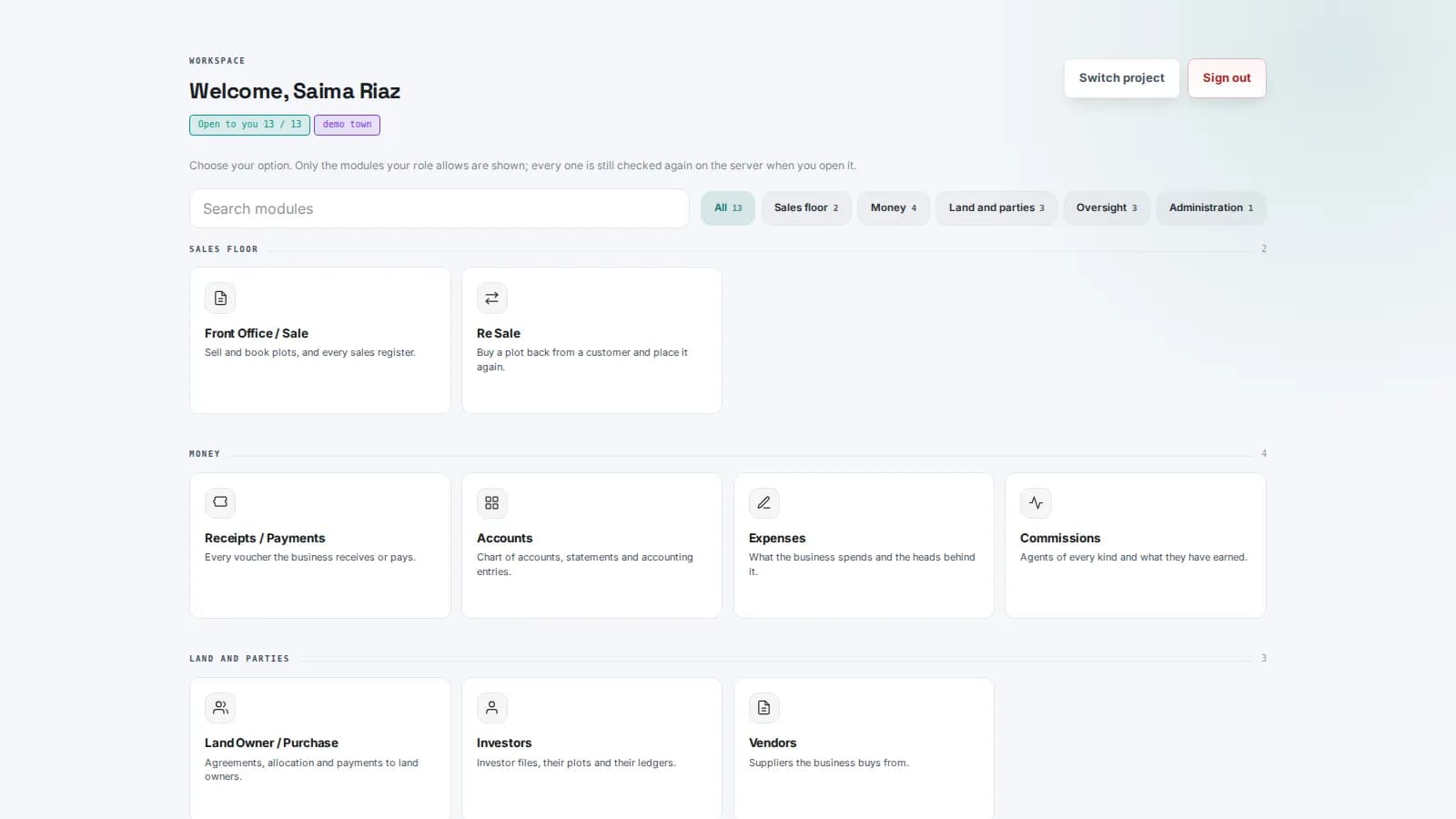
Housing society software in Pakistan means two different things. Here is what the developer's office needs for plots, files, installments and dealers, from 17 projects.
Read article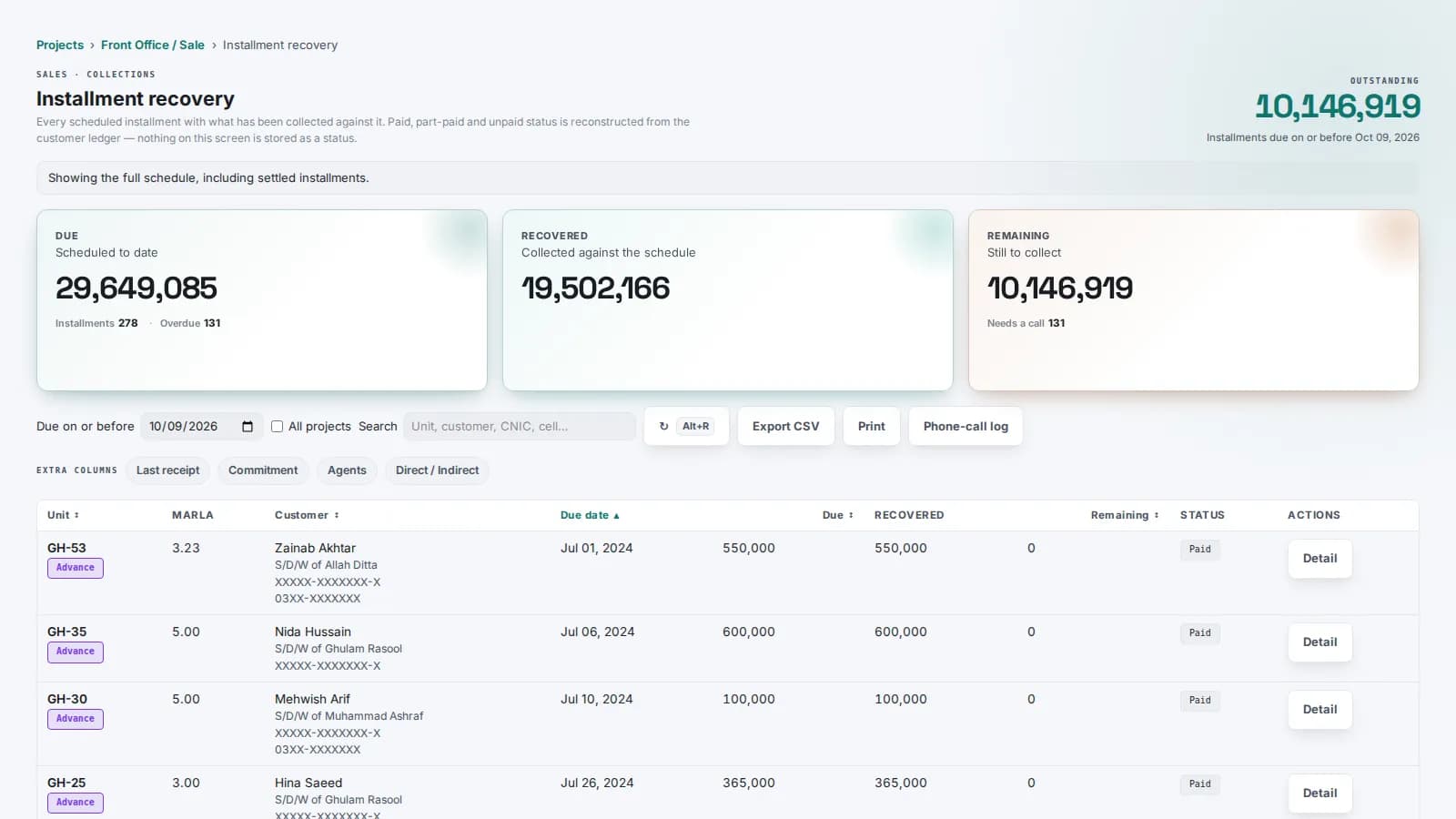
How plot installment software should track schedules, part payments, overdue files and defaulters for a housing scheme in Pakistan, from the team behind Turner 10.
Read article