"How much will it cost?" is usually the first real question on a call, and it should be. The annoying answer is "it depends". The useful answer is a number with the reasons attached, so here is ours.
For the kinds of ERP we build, custom ERP development costs roughly $15,000 to $56,000 and takes 7 to 14 weeks. That is a wide range, and most of this article is about what moves a project from one end of it to the other. Instead of a made-up example, I'll use systems we have built and still run: for a hospital, a housing developer, a jewellery business and a tailoring firm.
The short answer, by type of system
These are the typical ranges from our cost estimator. They are not marketing numbers: every price on our website comes from the same calculation.
| System |
Typical range |
Timeline |
| Order management / manufacturing ERP |
$15,000 to $24,000 |
7 to 9 weeks |
| Retail ERP and POS |
$16,500 to $27,000 |
7 to 10 weeks |
| Hospital management system |
$19,000 to $31,000 |
7 to 11 weeks |
| Jewellery ERP |
$32,500 to $52,500 |
10 to 14 weeks |
| Real estate ERP |
$34,500 to $56,000 |
10 to 14 weeks |
The calculation is simple enough to explain in two lines. We estimate the hours a traditional team would need, including testing and project management, take off 35% because AI agents do the repetitive part of the work, and price the rest at a blended rate of $25 to $35 an hour. More on that 35% below, because it's the part people are most sceptical about.
Why a real estate ERP costs more than a hospital system
People expect the hospital to be the expensive one. Hospitals feel complicated. So why is the real estate ERP nearly twice the price?
Because the hospital figure is for a first version and the real estate figure is for the full system, and in our estimator a full build costs about 1.9 times a first version. That single choice moves the price more than anything else in this article.
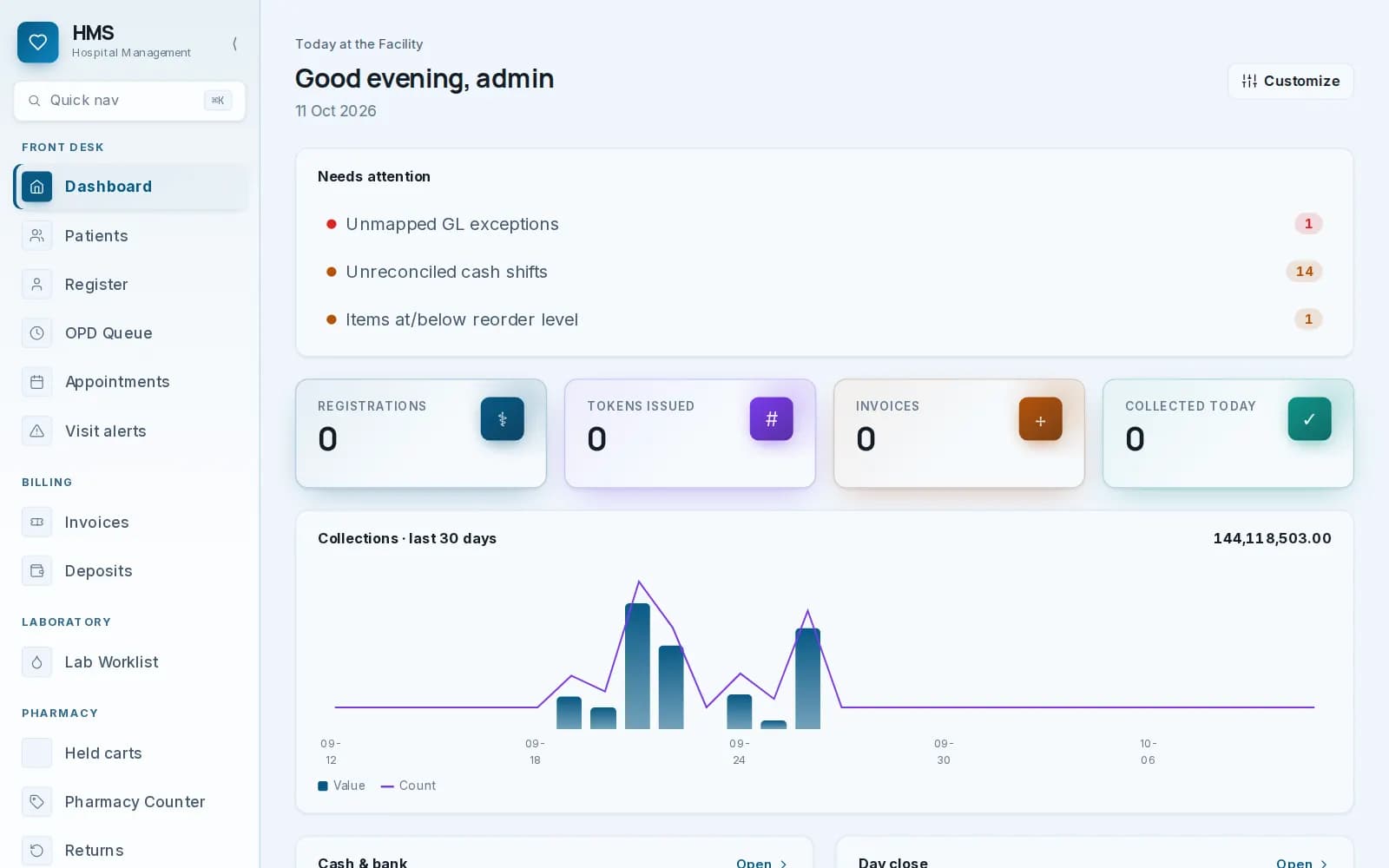
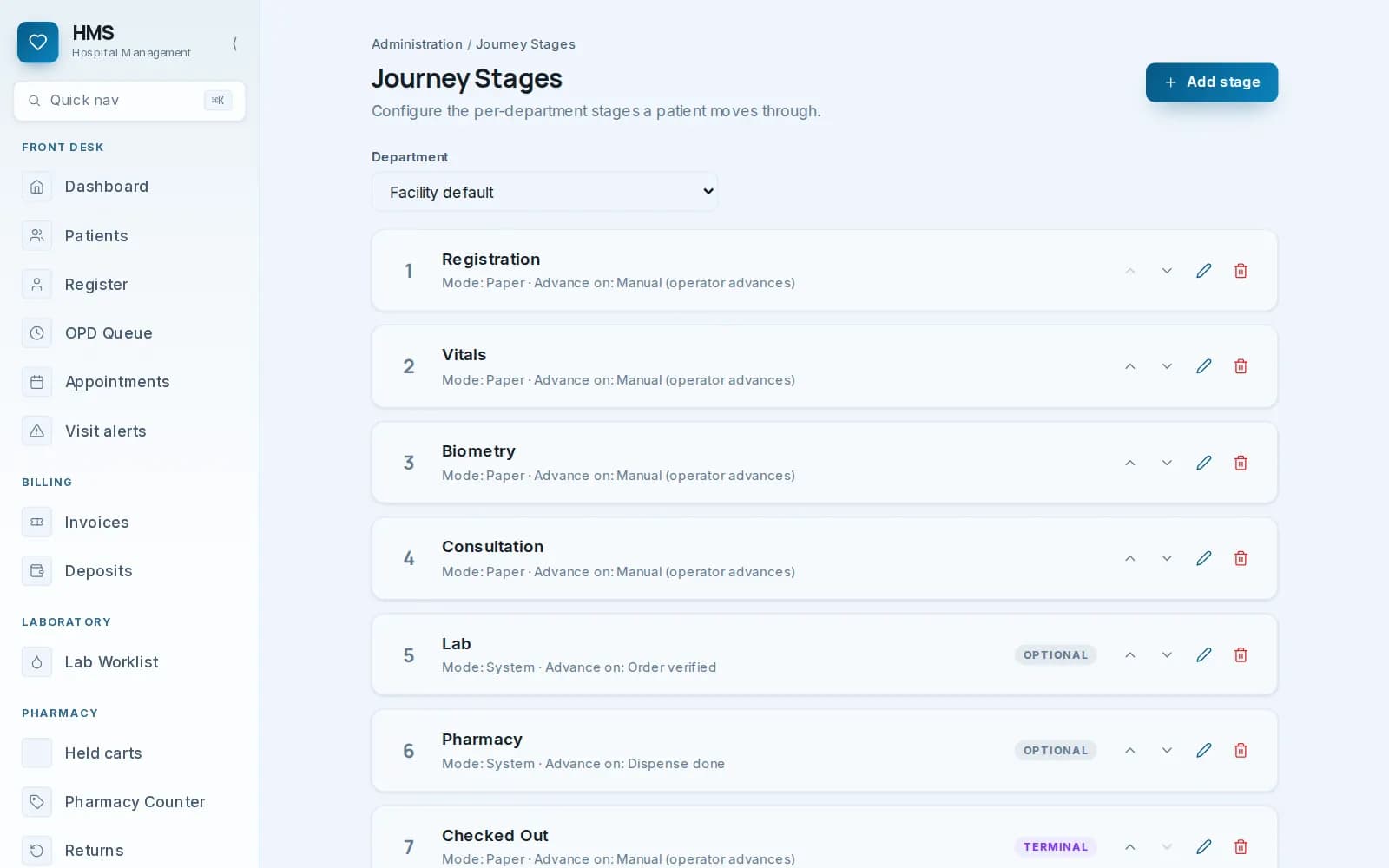
A hospital can go live on the core: registration, the OPD queue, the doctor's screen, lab, pharmacy and billing. Wards and procurement can follow a few weeks later without anyone losing money in the meantime.
A housing developer usually can't do that. When we built Turner 10, sales, receipts, installments, dealer commissions, land owner payments and the accounts all touched the same money on the same day. Going live with sales but not commissions just moves the spreadsheet somewhere else. So the first version is close to the whole thing: thirteen modules.
The jewellery ERP is priced as a full build for a similar reason. Stock, karigar work and sales are all measured in grams and karats, so there is no useful first version that leaves one of them out.
The lesson for your own budget: before asking what an ERP costs, ask what the smallest version is that your business could actually run on. That number is the one to budget first.
Where the money actually goes
Once scope is decided, five things decide most of the rest of the price.
1. The rules that make your business different
Every ERP has users, stock and accounts. The cost is in the rules that don't come in a box.
At the trust eye hospital behind EHMS, zakat, sadqa, trust and charity-box money each had to sit on its own ledger, so a zakat discount could never touch sadqa. In Turner 10, one plot sale can involve a freelancer, a sales officer and an investor's agent, each paid differently, so the system has five kinds of agent instead of one. In Ophir, every piece of jewellery carries its weight and karat from purchase, through the karigar, to a sale at that day's gold rate.
None of that is exotic to the people running those businesses. All of it is work. When you write your brief, the rules you think are "obvious" are the ones to spell out, because they are where the hours go.
2. Moving your old data
Migration is the line item people forget. Patients, plots, stock, open invoices, cheques that haven't cleared: it all has to come across, match the old system, and be checked by someone who knows what the numbers should be. In the estimator, migration adds about 60 hours to a traditional build. In real life it also takes a person on site. When we replaced the hospital's old system, we moved the running data and the staff across in person, and the hospital didn't close for a day. A script can copy rows. Only a person can confirm that the cheque book, the open bills and the patients still on the ward all made it.
3. Branches, companies and tenants
One shop is simple. Five branches that each need their own stock but shared reporting is not. A platform where each client company must never see another's data is harder again. Multi-branch or multi-tenant support adds roughly 60 hours before the AI saving, and it's worth every one of them if you need it, because adding it later means touching almost every screen.
4. Languages
English only is the cheapest. Adding Urdu or Arabic is not just translation: right-to-left layouts, fonts, number formats and printed documents all have to work. Turner 10 and EHMS both run in English, Urdu and Arabic, and the estimator adds about 40 hours for it. Cheap if planned from the start, painful if bolted on.
5. Other systems it has to talk to
Payment gateways, tax portals like FBR in Pakistan, accounting software, SMS and WhatsApp, a bank's API. Each integration is small on its own and adds up quickly. Each one also depends on someone else's documentation, which is the part of a project most likely to surprise everyone.
Why the same ERP can cost $25,000 or $250,000
If you have collected quotes from different countries, the spread can look absurd. It mostly comes down to two numbers: the hourly rate, and how many hours the team needs.
Take our hospital system as the example. A traditional team would need roughly 1,250 hours for it. Here is what those hours cost at the rates agencies typically publish, next to our own range:
| Who builds it |
Typical hourly rate |
Rough cost |
| Agency in the US or Canada |
$100 to $250 |
$125,000 to $310,000 |
| Agency in Eastern Europe |
$40 to $85 |
$50,000 to $105,000 |
| Traditional team in Pakistan or India |
$20 to $50 |
$25,000 to $62,000 |
| Eaquirs Tech, with AI agents |
$25 to $35, on about 35% fewer hours |
$19,000 to $31,000 |
The rates are typical published ranges, not quotes, and a good team at any rate is worth more than a cheap one that disappears. But the table explains most of the gap you will see. The rest is scope: make sure every quote describes the same modules before you compare the totals.
What AI agents change, and what they don't
We build with a team of AI agents: one plans, one drafts the architecture, two write the backend and the interface, one tests and one deploys a preview. A senior engineer reviews everything and is the only one who can approve a release. I've written about how that works in practice.
The 35% saving in our prices comes from the work agents are genuinely good at: forms, lists, filters, API endpoints, tests, documentation and migration scripts. On an ERP that's a large share of the hours, because an ERP is mostly forms, lists and reports.
What AI doesn't shorten is the thinking. It can't decide how your commission rules should work, or what happens to a plot when a buyer stops paying, or which ledger a charity discount comes from. Those decisions take the same time with or without agents. If anyone quotes you a price that seems to assume AI makes the decisions too, ask who is going to own them.
The costs after launch
The build is not the whole bill. Budget for three things after go-live:
- Hosting. For most ERPs this is modest, a cloud server and a managed database. It grows with users, files and backups.
- Support and fixes. Something will need adjusting in the first months, because real use always finds what testing didn't.
- Changes. Your business will change, and the software should follow. A common rule of thumb is to set aside 15 to 20% of the build cost per year for support and improvements. It's a starting point for your budget, not a quote.
Ask any vendor, us included, what support costs before you sign, and whether the same engineers who built the system will be the ones answering.
Custom ERP or Odoo: which is cheaper?
Often Odoo or ERPNext. I mean that.
If your business works the way most businesses in your industry work, an off-the-shelf ERP will be live sooner and cost less to start. The trust hospital behind EHMS looked at SAP and Odoo seriously before choosing us, and both are excellent products.
The maths changes in two situations. First, when your core rules don't fit, the customisation bill for a packaged ERP can pass the cost of building the thing properly, and you still end up with a system bent into shape. Second, when per-user licence fees meet a growing team. To compare honestly, multiply your expected user count by the monthly per-user price and by 36 months, add the partner's customisation and support fees, and put that next to a custom build plus three years of support. Sometimes the packaged ERP still wins. Sometimes it loses badly.
There's a side-by-side table on our custom ERP development page, including when we'll tell you to buy instead of build.
When a ready product is cheaper than both
There is a third option people overlook: a product someone has already built for your industry. Because the work is done once and then reused, it can cost a fraction of a custom build.
That's why our own EHMS hospital software starts from PKR 150,000 in Pakistan, while a hospital system built from scratch sits in the $19,000 to $31,000 range above. Same idea for X3 in retail. If a ready product covers most of what you need, customising it is usually the cheapest route to a system that fits.
How to get a number for your own project
- Try the cost estimator. Pick the type of system, the modules and the features, and you'll get a range and a PDF in about a minute.
- Write down the three rules that make your business different. The fund that can't mix with another, the commission that splits three ways, the stock that's measured in grams. These shape the price more than the module list.
- Ask for a written plan. We send one after a short call, with scope, team, timeline and price, and it's yours to keep whether or not you work with us.
Common questions
How much does a custom ERP cost in 2026? For the systems we build, typically $15,000 to $56,000 over 7 to 14 weeks. A first version with the core modules sits at the lower end; a full system with branches, several languages and integrations at the upper end.
Why do quotes for the same ERP vary so much between companies? Mostly hourly rates and scope. Agencies in the US and Western Europe often charge several times the rate of a team in Pakistan or Eastern Europe, and two quotes for "an ERP" can describe very different systems. Compare quotes module by module, not total against total.
Is it cheaper to build a custom ERP with AI? Yes, when AI is used for the repetitive work inside a process with human review. In our pricing it takes about 35% of the hours off a traditional build. It doesn't reduce the time spent on decisions, and it shouldn't reduce the time spent on review.
How long does custom ERP development take? Seven to fourteen weeks for the systems above, with a working demo every week. EHMS's first desktop version went live in six weeks, because the hospital's owner was flying back to the UK within a month.
Should we start with a first version or the full ERP? Start with the smallest version your business can genuinely run on. For a hospital that's the patient journey and billing. For a housing developer it's often most of the system, because sales, installments and accounts move the same money.
If you'd like a number for your own system, get a free project plan. Tell us the rules that make your business different, and we'll tell you honestly whether to build, customise or buy.