Healthcare · Saudi Arabia
Hospital Management Software in Saudi Arabia
In the Kingdom a hospital system is judged twice: at the reception desk, and by what reaches NPHIES and ZATCA. EHMS, the hospital ERP we built and run for a trust eye hospital in Pakistan, is Arabic-first and already has coverage checks, pre-authorization, a claims register and a denial work queue. For a hospital, polyclinic or medical complex in Riyadh, Jeddah or Dammam, we connect it to NPHIES, add national ID and Iqama registration with ICD-10-AM and SBS coding, and issue ZATCA e-invoices with 15% VAT. Pakistan is two hours ahead of Saudi time, so we work your full day.
In short
Hospital management software in Saudi Arabia is a hospital information system (HIS) that runs registration, clinics, lab, pharmacy and billing in Arabic, checks eligibility and pre-authorization through NPHIES before treatment, sends claims in the national format, and issues e-invoices ZATCA accepts. EHMS by Eaquirs Tech covers the hospital side; NPHIES and ZATCA integration are built and taken through onboarding for each facility. A hospital system typically costs $19,000 to $31,000, and a clinic edition $11,500 to $19,000.
- National ID or Iqama on the patient record
- Coverage, pre-authorization, claims and denials already in EHMS
- NPHIES connection built and onboarded for your facility
- ZATCA e-invoices with QR code and 15% VAT
- Arabic-first screens, English for the clinical team
How an insured visit moves through NPHIES
NPHIES, the Council of Health Insurance's platform, carries every insured visit from check-in to payment. These are the four exchanges a hospital system has to send and receive.
- EligibilityBefore the visit, the hospital asks the insurer through NPHIES whether the patient's policy is active and what it covers.
- Pre-authorizationFor services that need approval, the request goes with the diagnosis and planned procedure codes, and the approval number comes back.
- ClaimAfter the encounter, the claim goes out with ICD-10-AM diagnoses, SBS procedure codes and the approval attached.
- Payment and reconciliationThe insurer's payment notice is matched against each claim, and short payments land in the denial work queue.
EHMS already has a screen for each of these steps. The NPHIES connection itself is built for your facility and taken through NPHIES onboarding before go-live.
EHMS in Arabic
Screens from the live EHMS demo, switched to Arabic.
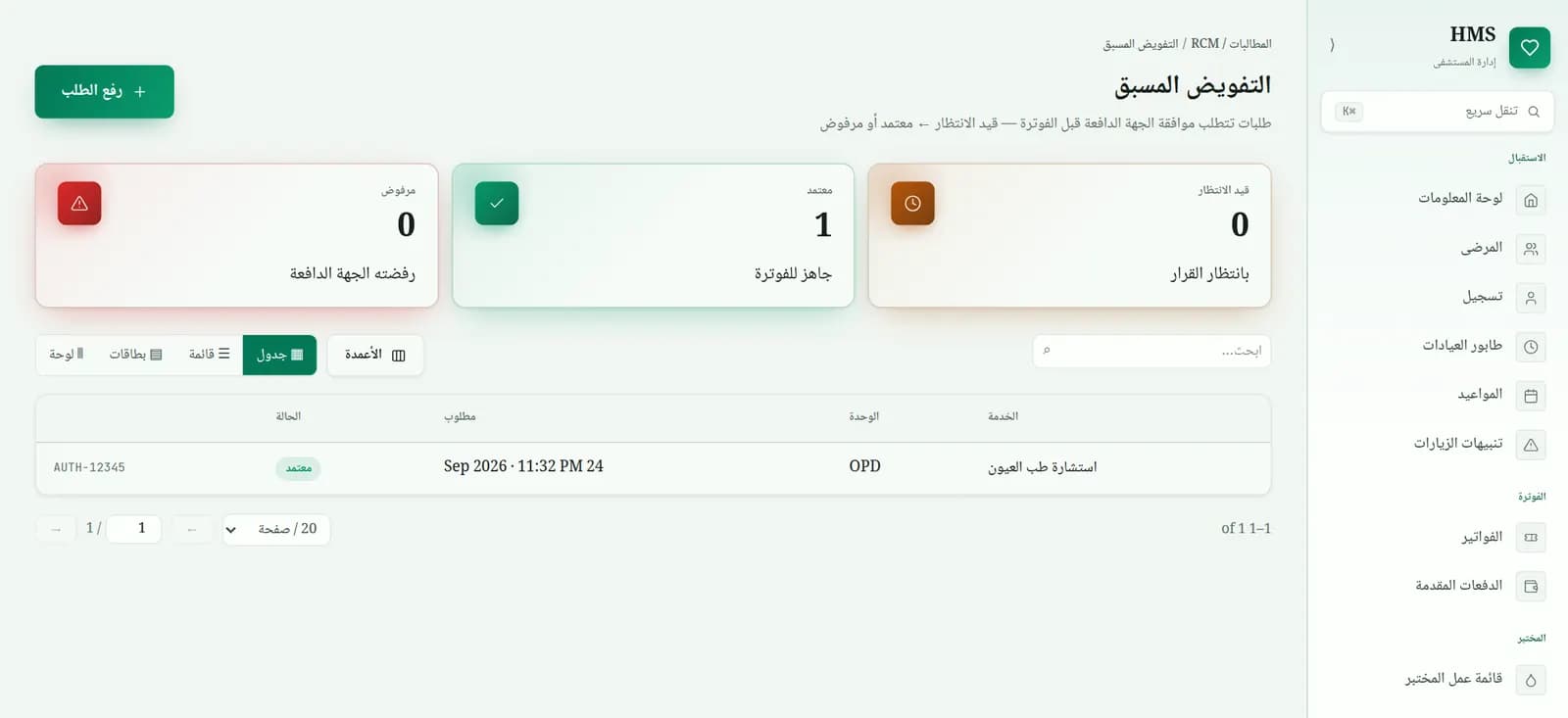
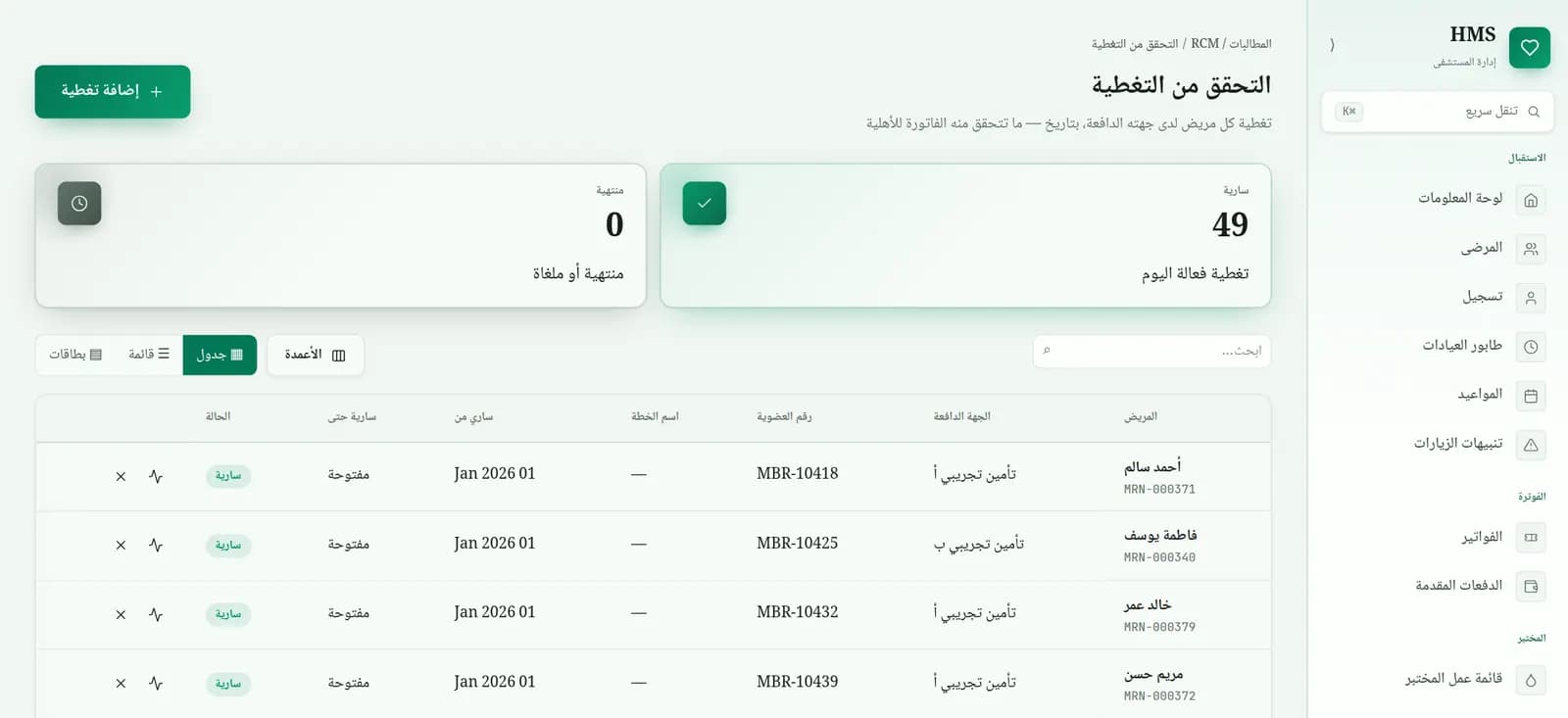
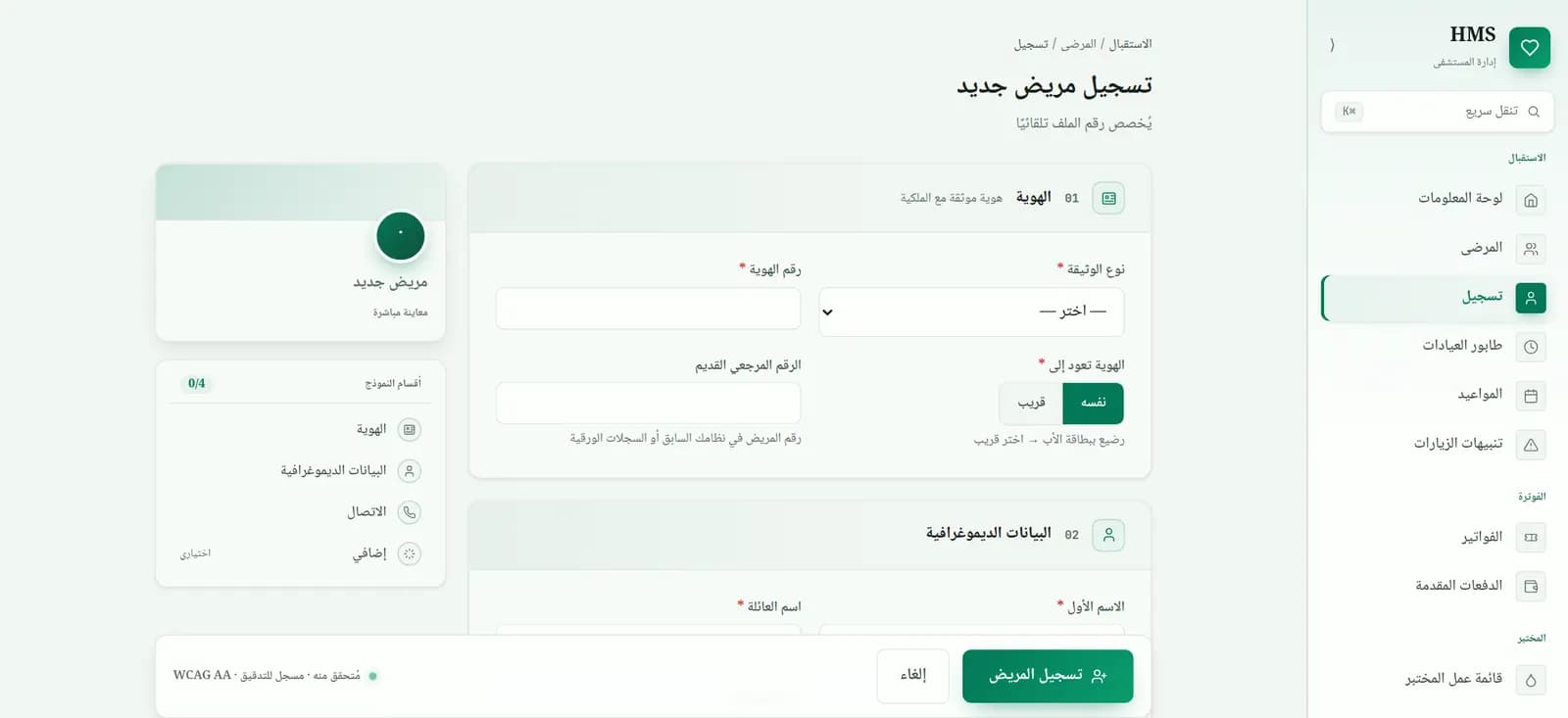
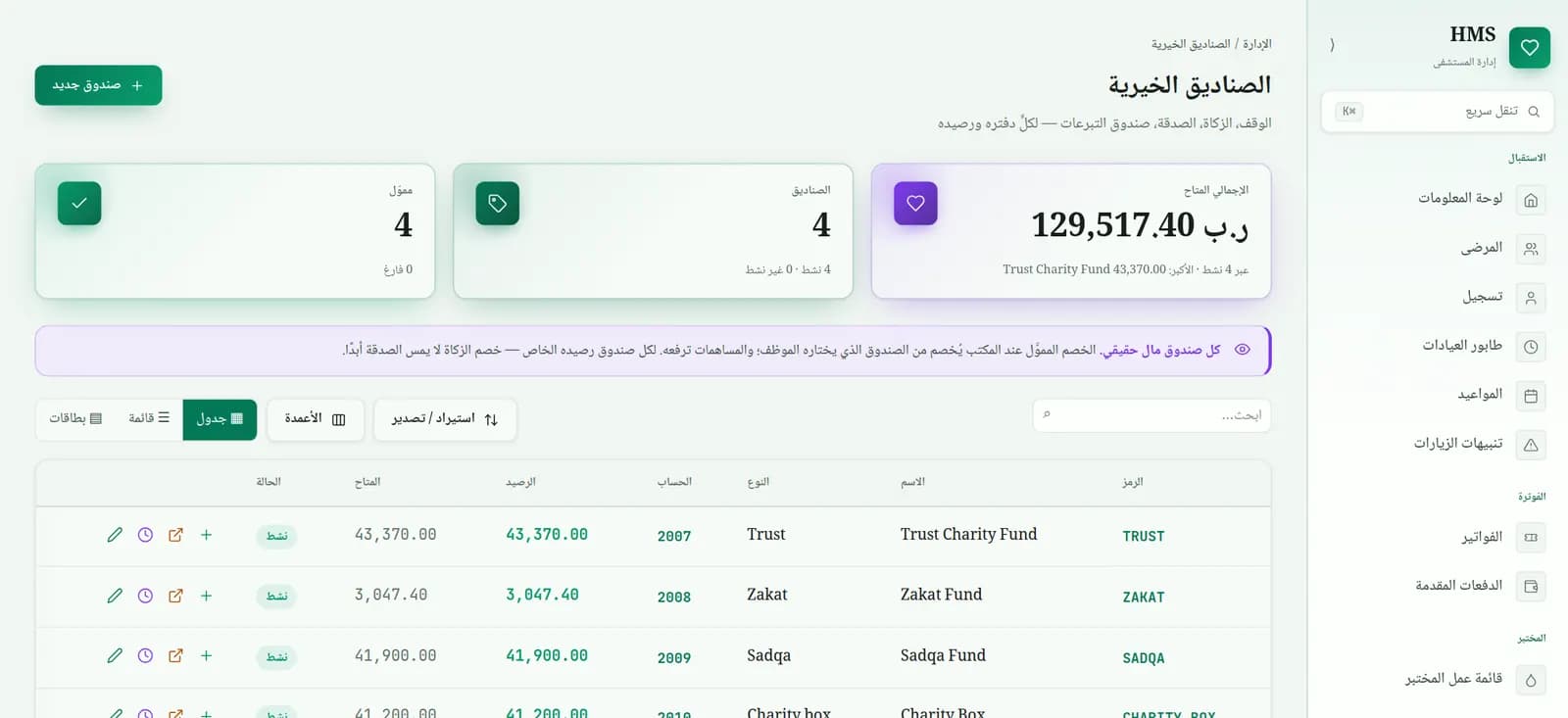
Live walkthrough
One healthcare workflow, end to end.
ReceptionPatient registered with national ID and insurance details
1/6 stepsSimulated run showing how data moves through a system like the one we build for healthcare.
Sound familiar?
- Rejections on NPHIESMissing pre-authorizations, code mismatches and late claims come back as rejections weeks later.
- E-invoicing in a separate toolThe hospital system bills the patient but ZATCA invoices come from somewhere else, so totals never match.
- Arabic that breaks on paperReceipts, reports and prescriptions print with broken Arabic letters or a left-to-right layout.
- Every clinic in the complex on its ownEach clinic in the medical complex runs separately, so stock, revenue and schedules never match at head office.
ZATCA e-invoicing in two phases
Every invoice a Saudi hospital issues falls under ZATCA's e-invoicing rules. Billing in EHMS is connected for the phase and wave your business falls under.
| Phase | In force since | What the hospital's invoices must do |
|---|---|---|
| Phase 1: generation | 4 December 2021 | Be issued electronically from a compliant system, with a QR code on simplified (patient) invoices |
| Phase 2: integration | 1 January 2023, in waves by revenue | Be cleared (business invoices) or reported within 24 hours (patient invoices) through ZATCA's Fatoora platform, as UBL XML |
ZATCA announces each wave and notifies the businesses in it; we connect billing in time for yours.
What we build
- NPHIES insuranceEHMS already has coverage check, pre-authorization, a claims register, a denial work queue and payer ageing; the link to the Council of Health Insurance's NPHIES platform is built and onboarded for your facility.
- Clinical codingICD-10-AM diagnoses and Saudi Billing System (SBS) procedure codes, checked before the claim is sent.
- Billing & ZATCA e-invoicingCash, insurance and corporate billing with 15% VAT and QR-coded e-invoices for ZATCA, plus ledgers, bank reconciliation and closing.
- Patient registration & ID/IqamaOne record per patient with national ID or Iqama, insurance details, visits and documents.
- OPD & appointmentsDoctor schedules, tokens and consultation notes.
- LaboratoryDigital orders, sample tracking and result entry with abnormal values flagged.
- Pharmacy & inventoryE-prescriptions, dispensing, automatic stock deduction and a controlled drug register.
- IPD, wards & reportsAdmissions, bed board, housekeeping and management dashboards.
- Polyclinics & branchesEvery clinic in a medical complex, or every branch, on one system with head-office reports.
- Zakat, sadaqah & waqf fundsEach charity fund on its own ledger; a funded discount draws down the fund the desk picks, fully auditable.
Where AI helps
- Pre-authorization requests checked against the policy before they reach NPHIES
- Rejections grouped by reason and insurer, so the same mistake is not sent twice
- Visit and discharge summaries drafted in Arabic for the doctor to approve
Hospital software for the Gulf
Built and running

Common questions
Is EHMS integrated with NPHIES?
Not out of the box today. EHMS already has coverage check, pre-authorization, a claims register, a denial work queue and payer ageing. For a Saudi project we build the NPHIES connection (eligibility, pre-authorization, claims and payment reconciliation) to the Council of Health Insurance's specifications and take it through NPHIES onboarding with your facility before go-live.
Does it issue ZATCA e-invoices?
For a Saudi deployment, yes. Invoices carry 15% VAT and the QR code, and billing connects to ZATCA's Fatoora platform for the integration wave your business falls under. We build and test this as part of the project.
Have you deployed EHMS in Saudi Arabia?
Not yet. EHMS runs at two hospitals in Pakistan, including a trust eye hospital in Chishtian. A hospital in Saudi Arabia would be among our first in the Gulf, so NPHIES, ZATCA and coding go into a written scope and a test environment before go-live.
Can the whole hospital work in Arabic?
Yes. Every screen runs in Arabic with a right-to-left layout, receipts and reports print in Arabic, and each user can switch to English or Urdu. Reception can work in Arabic while doctors use English on the same patient record.
How is hospital software priced in Saudi Arabia?
In US dollars: typically $19,000 to $31,000 for a hospital and $11,500 to $19,000 for a clinic edition, the same ranges as our cost estimator. NPHIES onboarding and your ZATCA phase move it most. The exact price comes in a written plan after we see the facility, and the plan is yours whether or not you work with us.
Where is patient data hosted?
In the Kingdom: on a Saudi cloud region or on a server in your hospital. Saudi data rules, including the Personal Data Protection Law, favour keeping patient data in the country, so we plan hosting around that from the start.
Free 30-minute call
Talk to the founder and leave with a plan.
There's no sales script. Before we talk, our AI agents map out your scope and pull up similar projects we've done, so the 30 minutes go on real answers about approach, timeline and a budget range.
YouYou pick a time and add one line about the project
1/5 steps- 30 minutes on Google Meet, Zoom or WhatsApp
- We'll tell you honestly if we're not the right fit
- A free written plan once we've talked
- NDA before you share details
- You own the code and IP
- Code in your repository
- Pay per milestone